Home » Places & Landmark » Japan » Enoshima in Kanji, Katakana and Hiragana

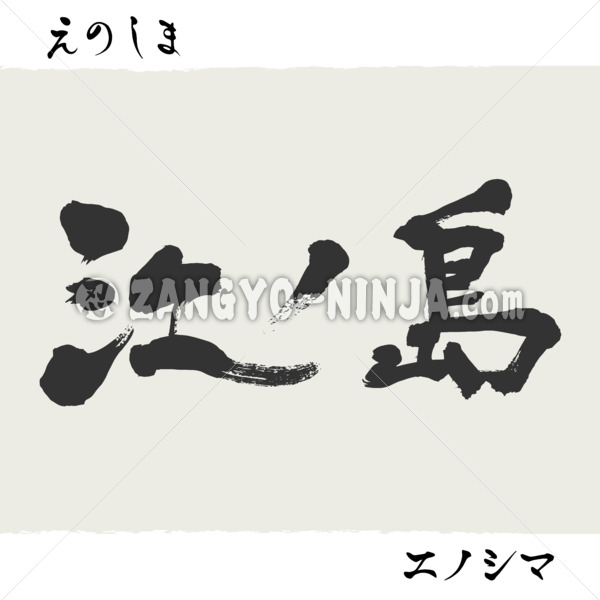
Enoshima in Kanji, Katakana und Hiragana

erstellt von Designer

$0.00$1,490.00

600x600
$0.00
1920x1920
$4.80
6000x6000
$9.80
Voll
$19.80
Voll
$980.00
Voll
$1,490.00
Categories: ,

What is Enoshima?

An island located in the northeastern part of Sagami Bay in Kanagawa Prefecture. It is connected to Katase on the opposite shore by the Benten Bridge and Enoshima Bridge, and is home to Enoshima Shrine (Enoshima Benten), which has been a place of deep religious devotion since the Kamakura period. The island is named after its resemblance to the character “江” (e).

The highest point is 60 meters above sea level, forming a plateau, offering a wide view of Sagami Bay, Izu, Hakone, Mount Fuji, Tanzawa, and Mount Oyama. Connected to the historic city of Kamakura, it serves as the center of Shonan tourism and has been included in international tourist routes, making it popular among both locals and foreigners since early times.

A recreational spot since the Kamakura period

Enoshima has been a recreational spot since the Kamakura period, attracting many Kamakura samurai. During the Edo period, it was frequently visited by Edo townspeople and travelers on the Tokaido Road, and a pilgrimage route was formed that included Oyama, Kamakura, Kanazawa Hakkei, and Kawasaki Daishi, leading to the development of a temple town. Even today, there are ryokan (traditional Japanese inns) that continue from the temple lodgings and regular lodgings of pilgrimage groups.

Many tourist spots remain today

At the highest point of the island, there is an observation tower and a tropical botanical garden. On the east coast, there is a yacht harbor and Shonan Port. The surrounding area is ideal for rock fishing. The opposite shore, Katase Beach, is a popular swimming spot.
The scene of New Year’s Eve and New Year’s Day, when the national highway was filled with people and motorcycle gangs, is no longer seen since the Showa era, but due to the branding of Shonan and the convenience of being able to reach it by train from the city center, it has been bustling with people regardless of the season or day of the week in recent years.

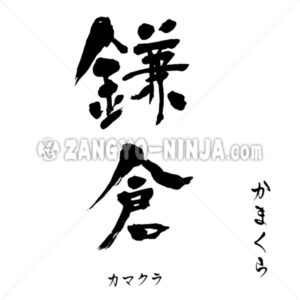
Erläuterung dieser Kalligrafie

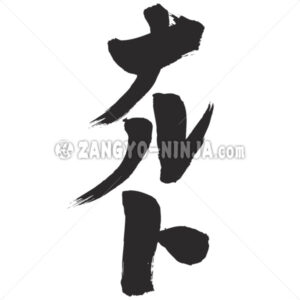
The top row is in hiragana, the middle row is in kanji, and “ノ” is in katakana. Although “の” is typically written in hiragana, either is acceptable. The bottom row is entirely in katakana.
Technische Details AI Vector, 207.17 KB
, , , , ,

People also views for about Enoshima

   
USA (Vereinigte Staaten von Amerika) in Kanji - Zangyo-Ninja

USA (Vereinigte Staaten von Amerika) in Kanji

Die Vereinigten Staaten von Amerika (USA), allgemein bezeichnet als [...]
Vektor
GRATIS~ Details anzeigen
Berg Takao in Kanji, Katakana und Hiragana – Zangyo-Ninja

Der Berg Takao in Kanji, Katakana und Hiragana

Ein mit drei Michelin-Sternen ausgezeichneter Berg, der Berg Takao [...]
Vektor
GRATIS~ Details anzeigen
Matsumoto in Kanji - Zangyo-Ninja

Matsumoto in Kanji

1. Es handelt sich um eine Stadt in der zentralen Region von Nag [...]
Vektor
GRATIS~ Details anzeigen

Vom Schöpfer Aokage empfohlene Werke

Tanaka in Kanji - Zangyo-Ninja

Tanaka in Kanji

Hallo, Herr Tanaka. Dies ist eine Erklärung des oder [...]
Vektor
GRATIS~ Details anzeigen

Kaffee in Kanji

Es ist eines der beliebtesten Getränke der Welt [...]
Vektor
GRATIS~ Details anzeigen
exzentrisch, beispiellos in Kanji - Zangyo-Ninja

exzentrisch, in Kanji beispiellos

Dinge tun, die noch nie jemand getan hat. Grenzen sprengen [...]
Vektor
GRATIS~ Details anzeigen
Mizuki im Nachnamen Kanji - Zangyo-Ninja

Mizuki im Nachnamen Kanji

Hallo, Herr Mizuki. Dies ist eine Erklärung des oder [...]
Vektor
GRATIS~ Details anzeigen
Morita in Kanji, Hiragana und Katakana – Zangyo-Ninja

Morita in Kanji, Hiragana und Katakana

Hallo, Herr Morita. Dies ist eine Erklärung des oder [...]
Vektor
GRATIS~ Details anzeigen
Shomon Raifuku in Kanji, das Sprichwort in Hiragana. 笑門来福 - Zangyo-Ninja

Shomon Raifuku in Kanji, das Sprichwort in Hiragana. 笑門来福

Glück stellt sich ganz natürlich in Häusern ein, die mit Lachen erfüllt sind [...]
Vektor
GRATIS~ Details anzeigen
AOKAGE
1017

Aokage

Er gewann mehrere Gold- und Silbermedaillen in japanischer Kalligrafie (Shodo). Er liebt Sushi und Sashimi. Da er seit seiner Kindheit Kalligrafie praktizierte, war sein Vater ein ausgebildeter Lehrer. Aokage (青景) leitet sich von der blauen Landschaft ab, die an das Meer und den klaren blauen Himmel erinnert, sowie vom blauen Schatten. Schatten symbolisiert einen Ninja.

Leute, die so klug sind wie du, schauen sich auch Folgendes an: