
Home » Edo & Classic history » Ishida as surname in Kanji, Katakana and Hiragana

Ishida als Familienname in Kanji, Katakana und Hiragana

erstellt von Designer

$0.00$1,490.00

600x600
$0.00
1920x1920
$4.80
6000x6000
$9.80
Voll
$19.80
Voll
$980.00
Voll
$1,490.00

Hello, Mr. Ishida. This is an explanation of the origin of the surname Ishida, which is shared by your ancestors and friends.

This surname is relatively common, with 260,000 people bearing it nationwide.
Meaning of each character in this surname:
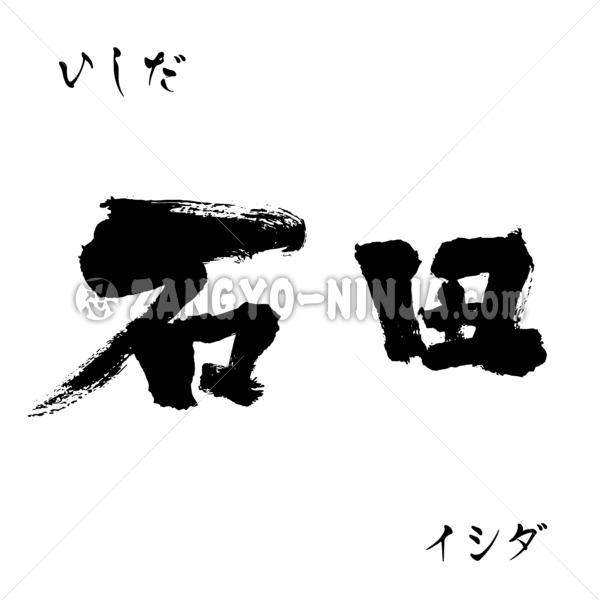
“石” (pronounced ishi) → stone
“田” (pronounced ta, da) → rice field
As basic background, rice farming was Japan’s primary agriculture.

Surnames originating from topography

This is a toponymic surname meaning “a field with many stones” or “a field with ground as hard as stone,” with roots found throughout the country. For example, places like Ishida Town in Nagahama City, Shiga Prefecture; Ishida in Isehara City, Kanagawa Prefecture; and Kamiishida and Shimoishida in Kofu City, Yamanashi Prefecture, are examples where the surname is derived from the place name.
It is also possible that the surname itself originated from such place names.

Surname of a Momoyama Period Military Commander

The clan of “Ishida Mitsunari” is well-known. He rose from being a local lord in Ōmi Province to become one of the Five Commissioners under the Toyotomi regime.
Mitsunari excelled in finance and administration, rising to become one of the Five Commissioners in the Toyotomi government. After Hideyoshi’s death in Keichō 5 (1600), Mitsunari raised arms against Tokugawa Ieyasu, one of the Five Elders. He supported Mōri Terumoto and Ukita Hideie, leading the Western Army at the Battle of Sekigahara. Defeated, he was executed.
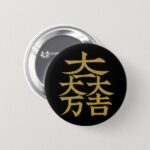
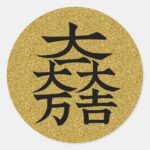
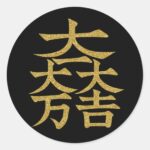
He is remembered for the banner he used at the time, bearing the phrase “大一大万大吉”(read as Daiichi Daiman Daikichi) This expressed the idealistic concept that “if one person serves all, and all serve one, the realm will achieve great peace (daikichi),” an ideal that resonates even today and parallels the rugby motto “One for all, all for one.”

Erläuterung dieser Kalligrafie

Die oberste Zeile ist in Hiragana, die mittlere Zeile in Kanji und die unterste Zeile in Katakana geschrieben, alle horizontal.
Technische Details AI Vector, 186.35 KB
, ,

People also views for about Ishida

   
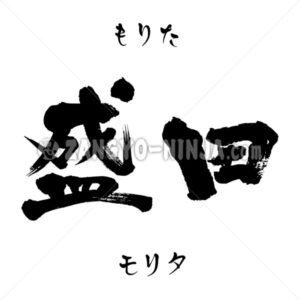
Morita in Kanji, Hiragana und Katakana – Zangyo-Ninja

Morita in Kanji, Hiragana und Katakana

Hallo, Herr Morita. Dies ist eine Erklärung des oder [...]
Vektor
GRATIS~ Details anzeigen
Mizuki im Nachnamen Kanji - Zangyo-Ninja

Mizuki im Nachnamen Kanji

Hallo, Herr Mizuki. Dies ist eine Erklärung des oder [...]
Vektor
GRATIS~ Details anzeigen
Tanaka in Kanji - Zangyo-Ninja

Tanaka in Kanji

Hallo, Herr Tanaka. Dies ist eine Erklärung des oder [...]
Vektor
GRATIS~ Details anzeigen
Abel und Aibel in Kanji mit Wappen (Maru-yose-Schriftart) – Zangyo-Ninja

Abel und Aibel in Kanji mit Wappen (Maru-yose Schriftart)

Beide sind „abel“ und „aibel“. Diese Wörter sind phonetisch [...]
Vektor
GRATIS~ Details anzeigen
Matsumoto in Kanji - Zangyo-Ninja

Matsumoto in Kanji

1. Es handelt sich um eine Stadt in der zentralen Region von Nag [...]
Vektor
GRATIS~ Details anzeigen

Vom Schöpfer Aokage empfohlene Werke

Kaffee in Kanji

Es ist eines der beliebtesten Getränke der Welt [...]
Vektor
GRATIS~ Details anzeigen
exzentrisch, beispiellos in Kanji - Zangyo-Ninja

exzentrisch, in Kanji beispiellos

Dinge tun, die noch nie jemand getan hat. Grenzen sprengen [...]
Vektor
GRATIS~ Details anzeigen
Shomon Raifuku in Kanji, das Sprichwort in Hiragana. 笑門来福 - Zangyo-Ninja

Shomon Raifuku in Kanji, das Sprichwort in Hiragana. 笑門来福

Glück stellt sich ganz natürlich in Häusern ein, die mit Lachen erfüllt sind [...]
Vektor
GRATIS~ Details anzeigen
Starker Trinker in Kanji – Zangyo-Ninja

Starker Trinker in Kanji

Ein starker Trinker ist jemand, der seinen Alkoholkonsum gut verträgt [...]
Vektor
GRATIS~ Details anzeigen
AOKAGE
1017

Aokage

Er gewann mehrere Gold- und Silbermedaillen in japanischer Kalligrafie (Shodo). Er liebt Sushi und Sashimi. Da er seit seiner Kindheit Kalligrafie praktizierte, war sein Vater ein ausgebildeter Lehrer. Aokage (青景) leitet sich von der blauen Landschaft ab, die an das Meer und den klaren blauen Himmel erinnert, sowie vom blauen Schatten. Schatten symbolisiert einen Ninja.

Menschen, die so fröhlich sind wie du, schauen sich auch Folgendes an: