
Mount Hiei, also known by the famous name “Fuji of the Capital,” as well as Eizan, Hokurei, and Tendai-san, is a mountain straddling western Ōtsu City in Shiga Prefecture and northeastern Kyoto City in Kyoto Prefecture.
A mountain revered by ancient people
Located on the border between Kyoto and Shiga Prefectures, it offers a panoramic view of Lake Biwa, Japan’s largest lake, praised in poetry as “Tendai Yakushi no Ike” (Tendai Yakushi Pond), to the east, and the historic cityscape of ancient Kyoto to the west.
Within this beautiful natural environment, its 1,200-year history and traditions have earned high international acclaim, leading to its designation as a UNESCO World Cultural Heritage Site in 1994 (Heisei 6).
History
Around 715 (Reiki 1), Fujiwara no Takechimaro established a Zen temple here. Later, in 788 (Enryaku 7), Saichō founded the Ichijō Shikan-in temple, using this site for his ascetic practices, establishing it as the headquarters of the Tendai sect.
From the late 11th century through the medieval period, Mount Hiei wielded immense power through its spiritual authority, wealth, and military might. Many monks abandoned mountain life to conduct religious activities in villages below the mountain or in various regions. From among them emerged the founders of medieval sects: Hōnen, Shinran, Nichiren, and Dōgen.
In 1571 (Genki 2), Oda Nobunaga’s attack on Enryaku-ji destroyed all its halls and pagodas, said to number 3,000, and the monks abandoned the mountain. However, reconstruction began with the aid of Toyotomi Hideyoshi and Tokugawa Ieyasu, and various halls were restored by Tenkai.
Although protected by the shogunate during the Edo period, it lost its former religious authority. Following the separation of Shinto and Buddhism in the early Meiji era, Hiyoshi Taisha Shrine was separated, leading to a period of decline. However, it now attracts devotion as the head temple of the Tendai sect.
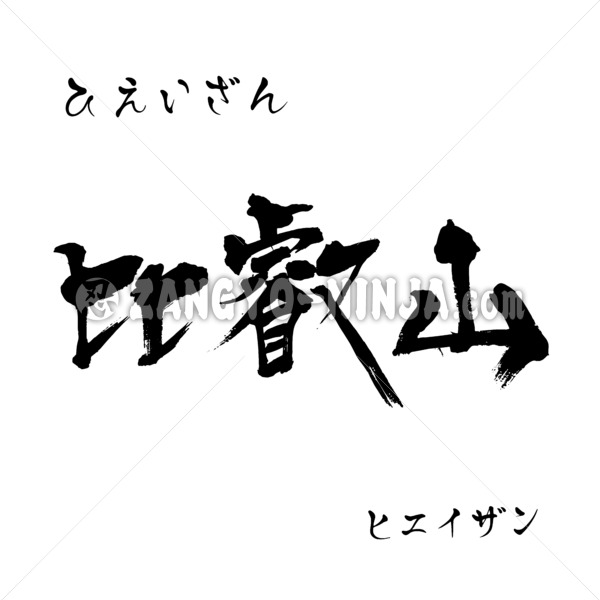
Erläuterung dieser Kalligrafie
Die oberste Zeile ist in Hiragana, die mittlere Zeile in Kanji und die unterste Zeile in Katakana geschrieben, alle horizontal.