
Home » Edo & Classic history » Takeda in Kanji, Hiragana and Katakana

Takeda in Kanji, Hiragana and Katakana

erstellt von Designer

$0.00$1,490.00

600x600
$0.00
1920x1920
$4.80
6000x6000
$9.80
Voll
$19.80
Voll
$980.00
Voll
$1,490.00

The surname of a warlord who ruled the area around present-day Yamanashi Prefecture during the Warring States period.

A renowned general known as the “Tiger of Kai.” Takeda Shingen was the surname of a warlord who governed Kai Province (present-day Yamanashi Prefecture) during the Warring States period (1467–1615).
Not only for his military prowess, but also for building the Shingen Embankment along the Kamabun River to control flooding and enable new rice field development. It is said that Shingen was beloved by his subjects and remains a popular local hero today because he focused on civil administration.
He is famous for employing the ancient Chinese military strategy “Wind, Forest, Fire, Mountain (Furinkazan)” from Sun Tzu’s Art of War.
In his later years, Shingen launched a campaign to march on Kyoto. He crushed the Tokugawa forces at the Battle of Mikatagahara in Totomi Province (present-day Shizuoka Prefecture), but died at the age of 53 due to illness.

Hello, Mr. Takeda. This is an explanation of the origin of the surname Takeda, which is shared by your ancestors and friends.

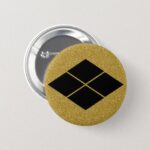
Originating from Takeda Village in Naka District, Hitachi Province (present-day Ibaraki Prefecture), it is a branch of the Yoshimitsu lineage of the Seiwa Genji (descendants of Emperor Seiwa granted the Minamoto surname), one of Japan’s foremost noble families.
Sometimes the root lies in the terrain itself. The actual etymology is said to derive from “Takeda” (Bamboo and Rice field), with the samurai Takeda clan later altering the characters. Some locations actually feature such plantations. It can also refer to fields near bamboo groves.
Approximately 190,000 Japanese people bear this surname nationwide, ranking 89th in surname frequency.

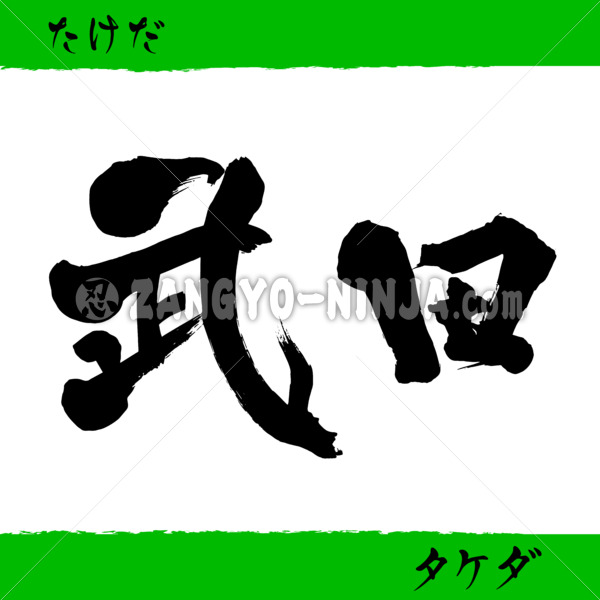
Erläuterung dieser Kalligrafie

The top row is hiragana, the middle row is kanji, and the bottom row is katakana, all written horizontally.
Technische Details AI Vector, 156.82 KB
, , , ,

People also views for about Takeda

   
Ninjutsu wrote vertically in Kanji - Zangyo-Ninja

Ninjutsu wrote vertically in Kanji

Description for Ninjutsu A martial art that employs [...]
Vektor
GRATIS~ Details anzeigen
Mizuki im Nachnamen Kanji - Zangyo-Ninja

Mizuki im Nachnamen Kanji

Hallo, Herr Mizuki. Dies ist eine Erklärung des oder [...]
Vektor
GRATIS~ Details anzeigen
Tanaka in Kanji - Zangyo-Ninja

Tanaka in Kanji

Hallo, Herr Tanaka. Dies ist eine Erklärung des oder [...]
Vektor
GRATIS~ Details anzeigen
Matsumoto in Kanji - Zangyo-Ninja

Matsumoto in Kanji

1. Es handelt sich um eine Stadt in der zentralen Region von Nag [...]
Vektor
GRATIS~ Details anzeigen
Morita in Kanji, Hiragana und Katakana – Zangyo-Ninja

Morita in Kanji, Hiragana und Katakana

Hallo, Herr Morita. Dies ist eine Erklärung des oder [...]
Vektor
GRATIS~ Details anzeigen

Vom Schöpfer Aokage empfohlene Werke

Kaffee in Kanji

Es ist eines der beliebtesten Getränke der Welt [...]
Vektor
GRATIS~ Details anzeigen
exzentrisch, beispiellos in Kanji - Zangyo-Ninja

exzentrisch, in Kanji beispiellos

Dinge tun, die noch nie jemand getan hat. Grenzen sprengen [...]
Vektor
GRATIS~ Details anzeigen
Shomon Raifuku in Kanji, das Sprichwort in Hiragana. 笑門来福 - Zangyo-Ninja

Shomon Raifuku in Kanji, das Sprichwort in Hiragana. 笑門来福

Glück stellt sich ganz natürlich in Häusern ein, die mit Lachen erfüllt sind [...]
Vektor
GRATIS~ Details anzeigen
Starker Trinker in Kanji – Zangyo-Ninja

Starker Trinker in Kanji

Ein starker Trinker ist jemand, der seinen Alkoholkonsum gut verträgt [...]
Vektor
GRATIS~ Details anzeigen
AOKAGE
1017

Aokage

Er gewann mehrere Gold- und Silbermedaillen in japanischer Kalligrafie (Shodo). Er liebt Sushi und Sashimi. Da er seit seiner Kindheit Kalligrafie praktizierte, war sein Vater ein ausgebildeter Lehrer. Aokage (青景) leitet sich von der blauen Landschaft ab, die an das Meer und den klaren blauen Himmel erinnert, sowie vom blauen Schatten. Schatten symbolisiert einen Ninja.

Menschen, die so fröhlich sind wie du, schauen sich auch Folgendes an: