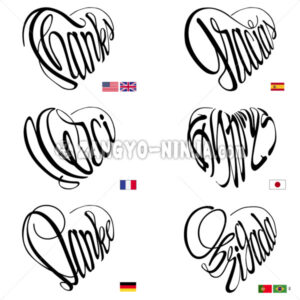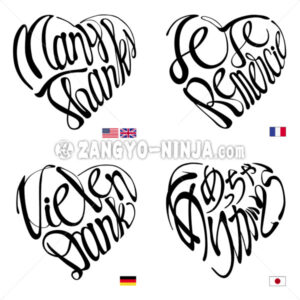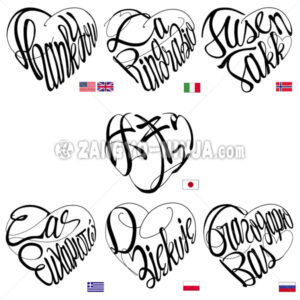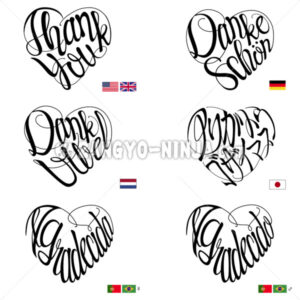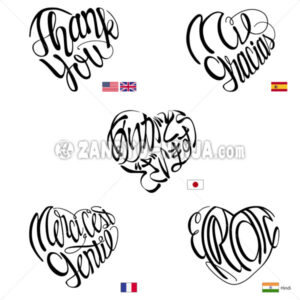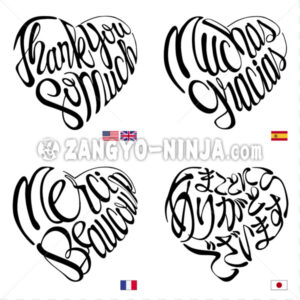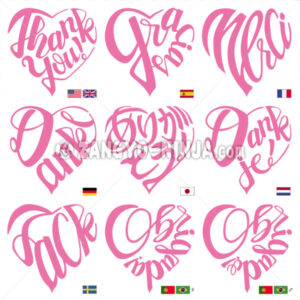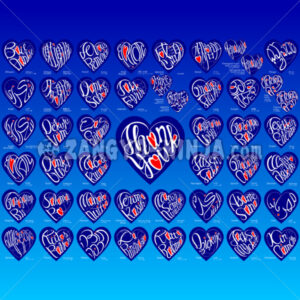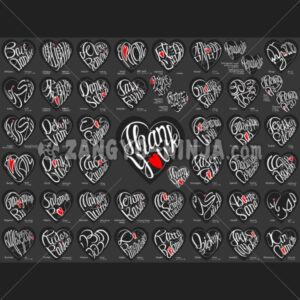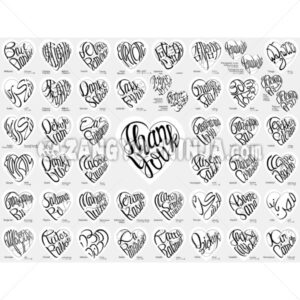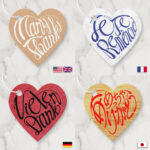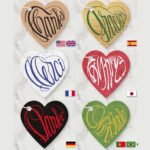
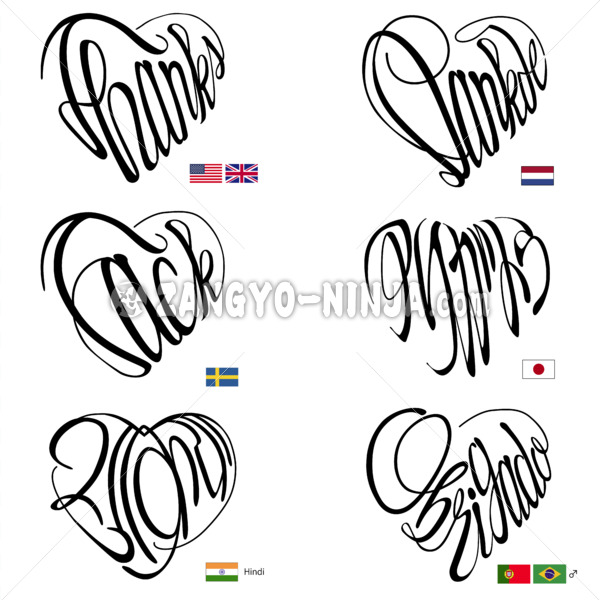

Thanks is expressed in English, Dutch, Swedish, Portuguese (male), Japanese Katakana and Indian Hindi as a heart-shaped writing style.
And theme is “Heart of Gratitude”.
The Japanese phrase “thanks” is written in a basic form.
This Japanese phrase “arigatou” is the basic form of the word “thanks”. Although there are ways to write it that include Kanji characters, it is generally written only in Hiragana. “Arigatou” should be used for siblings, friends, and other close people, while ‘arigatou gozaimasu’ should be used for business, formal occasions, and when dealing with elders. It is a polite form of “Arigatou”.
These are the derivatives of “Arigatou”.
・Arigaou in Hiragana (Thanks in Hiragana)
・Arigatou Gozaimasu (Thank you in Hiragana)
・Arigatou Gozaimasu (Thank you in Katakana)
・Meccha Arigaou (Many Thanks in Hiragana)
・Makotoni Arigatou Gozaimasu (Thank you so much in Hiragana)
What is Japanese Katakana?
Japanese is a rare language that uses kanji, hiragana, and katakana interchangeably in writing. Katakana, in particular, has a short history and can be said to have been derived from hiragana, but in Japan people learn hiragana at the same time or after learning hiragana. Japanese people do not consciously distinguish between the two, but katakana is often used when translating foreign words and onomatopoeic words into Japanese.
The appearance of many words is simpler and less rounded than hiragana.
Katakana has many forms similar to hiragana.
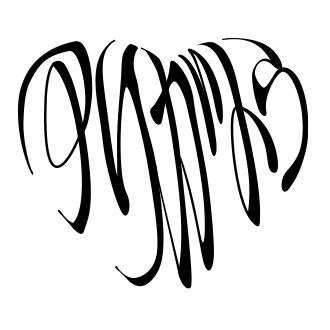
Using this piece “Arigatou” as an example, there are three katakana characters that resemble hiragana.
The hiragana “り” in the second character “り” and the katakana “リ” have almost identical shapes, while the hiragana “が” in the third character “が” has three dots and the katakana “ガ” has two. The last character “う” in hiragana has the dots separated, while in katakana “ウ” is angular with the dots clustered together.
As for this work, following the calligraphic atmosphere, even the katakana is designed to be rounded. Even if it is rendered in a hiragana style, it is still clearly written in katakana.
Additional languages are available. Thanks in Hindi.

The vertical lines seem to mean something like the boundary of each word, and the design is curved into a heart shape.