
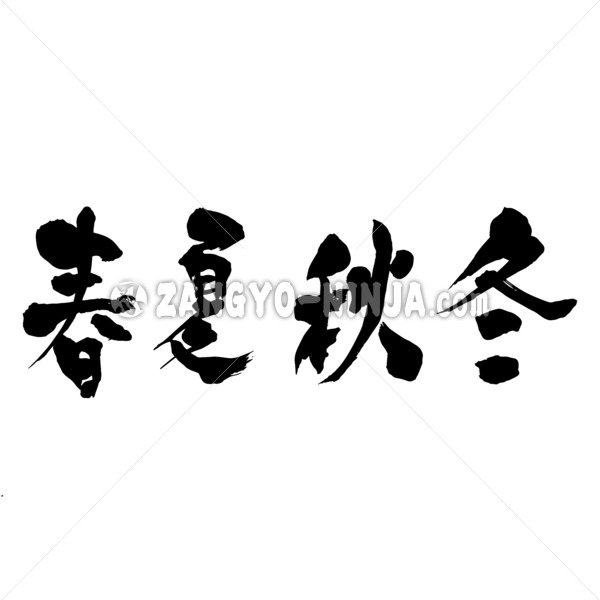

Description for the four seasons
In Japanese, the four seasons are referred to as “haru, natsu, aki, fuyu”, “shunka, shuto”, or “hito to se” (one year).
In Japan, people enjoyed the changing scenery around them throughout the four seasons and the calendar, and decided when to sow seeds and harvest crops.
Spring – Haru
One of the four seasons. It refers to the period between winter and summer, from the beginning of spring (around February 4) to the day before the beginning of summer (around May 6). Astronomically, spring is from the vernal equinox to the summer solstice, and meteorologically, it is March, April, and May in the solar calendar.
Cherry blossoms bloom during this season.
Summer – Natsu
Astronomically, summer is from the summer solstice (around June 22) to the autumnal equinox (around September 23). In terms of the solar terms, it is from the start of summer (around May 6) to the day before the start of autumn (around August 7). Customarily, it refers to June to August.
It is the hottest of the four seasons, with long days and short nights. In recent years, it has become extremely humid, with temperatures exceeding 40°C in some areas.
Autumn – Aki
Autumn is defined as the period from the start of autumn (around August 8) to the day before the start of winter (around November 7). In terms of months, it corresponds to July, August, and September in the lunar calendar, and August, September, and October in the solar calendar.
This season is cool and refreshing, with the harvest of grains and fruits, and the leaves of trees turning red.
Winter – Fuyu
In astronomy, winter is defined as the period from the Winter Solstice (around December 22) to the Vernal Equinox (around March 22). In the 24 solar terms, it is the period from the Start of Winter (around November 7) to the day before the Start of Spring (around February 4). In common usage, it refers to the months of December to February.
It is the coldest season of the year, with some regions experiencing heavy snowfall.
The disappearance of the four seasons
In recent years, due to the effects of global warming, temperatures have been rising, and spring and autumn tend to be extremely short.


![[Kanji] His Majesty the King T-Shirts](https://www.zangyo-ninja.com/wp-content/uploads/kanji_his_majesty_the_king_t_shirt-white_jg9nh_1024-150x150.jpg)


![[Escudos familiares] Tres flores de crisantemo Botón redondo](https://www.zangyo-ninja.com/wp-content/uploads/family_crests_flowers_pinback_button-3-chrysanthemum_k945w_1024-150x150.jpg)