

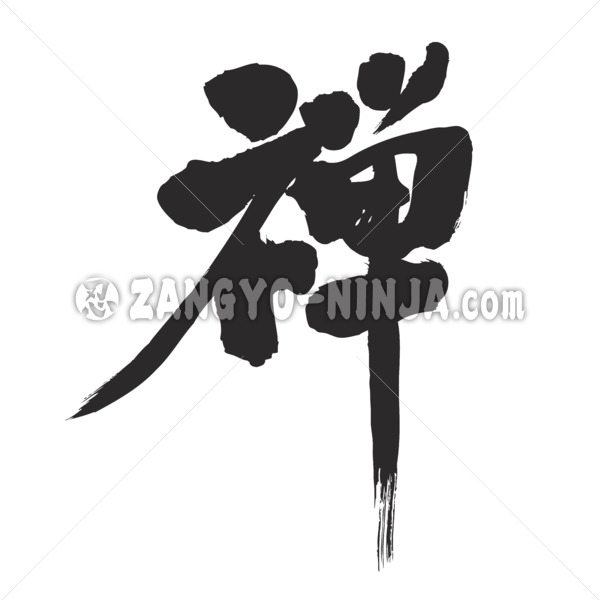

Brought from China around the 7th century, Zen originally referred to the teachings and practices of the Zen sect, a branch of Buddhism that developed in Japan, but is known today as a philosophy related to meditation and mindfulness.
History of Zen
Zen is a term that refers to the teachings and philosophy of the Zen sect, a branch of Buddhism, and its practices.
The founder of Zen Buddhism is said to be the Indian Buddhist monk Bodhidharma.
Zen in Buddhist terminology is an abbreviation of “zenna,” the transliteration of the Sanskrit word “dhyana,” meaning “to unify the mind and pursue the truth.
Zenna (or zenjing) refers to the state in which the mind is no longer agitated through ascetic practice, and the goal is to relive the enlightenment of the Buddha, the founder of Buddhism, through ascetic practice.
Zen Buddhism originated in China from Dharma’s nine years of meditation (Dharma traveled from India to China and sat for nine years in Shaolin Temple in the mountains east of Luoyang, facing a wall to attain enlightenment), and from the late Tang Dynasty (7th to 8th century), a branch of Buddhism centering on zazen was called “Zen Buddhism. Zen Buddhism later spread to the Tang Dynasty.
Zen Buddhism subsequently developed from the Tang to the Song dynasties.
Famous Zen words
The phrase “one lifetime, one meeting” was coined by Rinzai Gigen, a Zen monk of the Tang Dynasty in China who became the founder of the Rinzai school of Zen Buddhism.
It is one of the most famous Zen words and has multiple interpretations.
Sen no Rikyu, the great master of the tea ceremony, valued it, and it is said to express the spirit of the tea ceremony: “This moment will never come around again. It has become widely known as meaning “Let’s cherish each encounter.
Japanese Culture Influenced by Zen
Suiboku-ga
Suiboku-ga (ink painting) is an ink painting technique that originated in China during the Tang Dynasty.
It was introduced to Japan by Chinese monks in the Kamakura period (1185-1333), along with Zen Buddhism and themes that expressed Zen philosophy.
In the Muromachi period (1333-1573), Zen culture was promoted by the shogunate, which patronized Zen Buddhism. Painting subjects gradually became more Japanese, and such monks as Sesshu (1420-1506) and Shuwen (1414-1463) were active in this field.
Bonsai
Bonsai, like Zen, is another culture that came to Japan from China.
Originally practiced in the Tang Dynasty, bonsai was developed in Japan during the Heian Period (794-1192) by placing soil, sand, stones, moss, plants, and trees on trays to create natural landscapes.
Bonsai spread widely as a hobby of the samurai class that supported Zen culture, and by the Edo period (1603-1867), it had spread to the general public.
Like karesansui (dry landscape) and sansui-zu (landscape painting), bonsai is characterized by its ability to imitate natural scenery in a small space.














![[Kanji] Camisetas Zen](https://www.zangyo-ninja.com/wp-content/uploads/kanji_zen_t_shirt-white_jy9v0_1024-150x150.jpg)
![[Kanji] Camisetas Zen](https://www.zangyo-ninja.com/wp-content/uploads/kanji_zen_t_shirt-couple_uiz6i_1024-150x150.jpg)