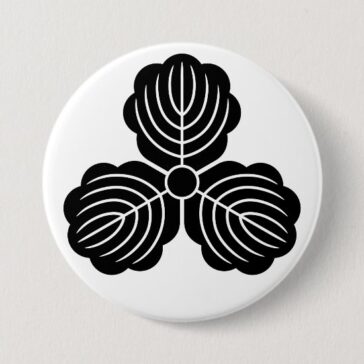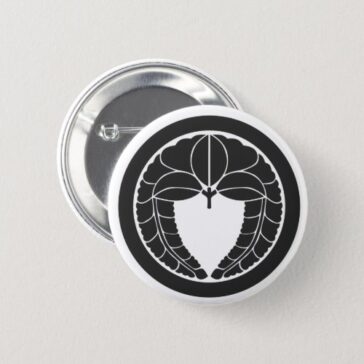

[Blagues familiales] Bouton à épingle représentant 3 roses trémières à l'intérieur d'un cercle
|

Il s'agit du blason le plus célèbre de la famille Mitsuha Aoi au Japon, utilisé par la famille du shogun Tokugawa pendant des générations durant l'époque d'Edo. [Blason familial] Badge à épingle représentant trois roses trémières dans un cercle
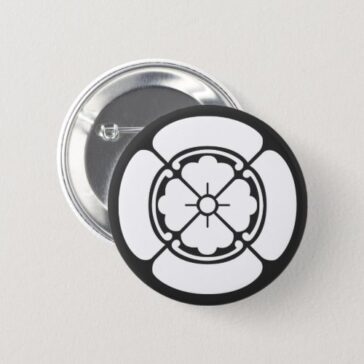
[Blagues de famille] Boutons à épingle représentant 3 roses trémières à l'intérieur d'un cercle
|

3 hollyhocks inside circle pinback buttons It is the most famous family crest of Mitsuha Aoi in Japan and has been used by the Shogun Tokugawa family for generations during the Edo period. It is the black and white inversion design.

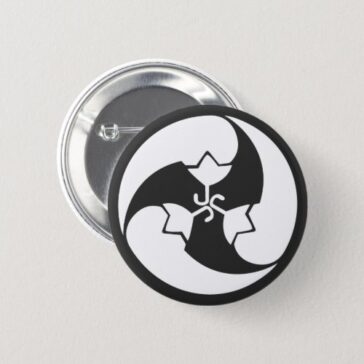
[Blagues familiales] Mokko à quatre côtés à l'intérieur d'une fleur Karahana Bouton rond
|

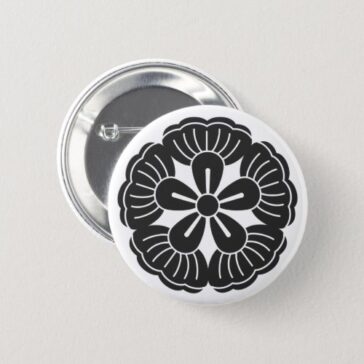
Le Mokko à quatre faces à l'intérieur d'une fleur de Karahana représente Kamon. Ce symbole végétal représente la vieillesse dans la famille japonaise. Il s'agit d'une inversion négative-positive. [Blason familial] Bouton rond Mokko à quatre faces à l'intérieur d'une fleur de Karahana

[Blagues familiales] Feuille de Kaji avec cercle Bouton rond
|

Kaji leaf for Kamon. This family crest features a circle drawn around a pattern of kaji leaves. Kaji trees are considered sacred because their leaves are used as vessels for offerings before the gods, and they eventually came to be used as divine crests. It can be found by clicking the button below. The … Read More

[Blagues familiales] Bouton classique Mitsudomoe à rotation droite
|

Il s'agit d'un « Mitudoomoe » (triple tomoe) tournant dans le sens horaire. Traditionnellement, le sens horaire est représenté par une rotation vers la droite. Le Mitudoomoe standard est présenté ici. Vous pouvez le consulter en cliquant sur le bouton ci-dessous. Le blason familial blanc est masqué. Cliquez sur le bouton « Modifier ce motif » pour afficher le blason blanc, masquer le blason noir, et… Lire la suite

[Blagues familiales] Neuf feuilles de bambou, bouton rond
|

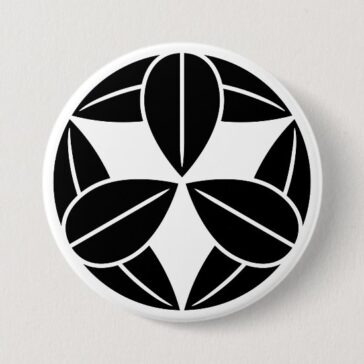
This family crest depicts three bamboo leaves arranged in a set, with three such sets joined together to form a circular design. Bamboo leaves have been considered sacred plants since ancient times, and even today they are used in Shinto rituals. They were adopted as a family crest for their auspicious significance. It can … Read More

[Blagues familiales] 5 fleurs de kudzu, bouton rond
|

Blason familial (Kamon) : symbole et graphisme d'une personne âgée. Sept herbes d'automne. Il s'agit d'une vigne vivace de la famille des légumineuses qui fleurit en violet. Elle est réputée pour sa grande fertilité. Le vieil homme l'a probablement intégrée au blason en raison de son goût et de ses propriétés. [Blason familial] 5 Fleurs de kudzu. Cliquez sur le bouton… Lire la suite

[Blagues familiales] Bouton rond Hagi enlacé
|

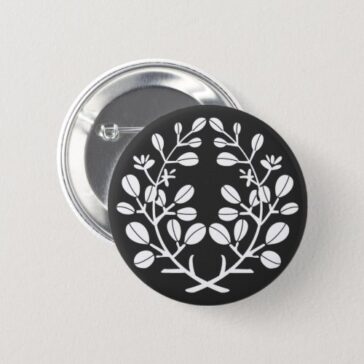
[Family Crests] Hugging Hagi Round Button Hugging Hagi for Kamon. Nature plants symbol and graphics at old age for Japanese family. It’s negative positive inversion. note. Hagi: A short deciduous shrub.It is counted as one of the seven autumn herbs and is one of the familiar plants for Japanese people.

[Blagues de famille] Bouton rond classique à trois feuilles de chêne
|

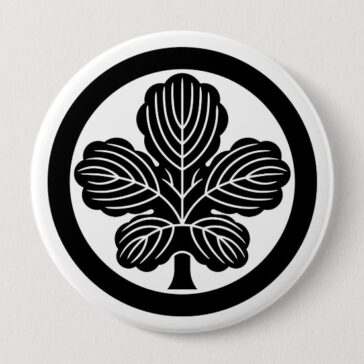
This family crest depicts three broad oak leaves spread out in three directions. Oak leaves were revered as sacred since ancient times, having been used as vessels for presenting offerings to the gods. It can be found by clicking the button below. The white family crest is hidden. Click the “Edit this design” button … Read More

[Blagues familiales] Bouton rond en forme de piment dessiné par Tomoe
|

[Family Crests] Tomoe designed chili peppers Round Button Tomoe designed chili peppers for Kamon. Nature plants symbol and graphics at old age for Japanese family. It’s negative positive inversion.

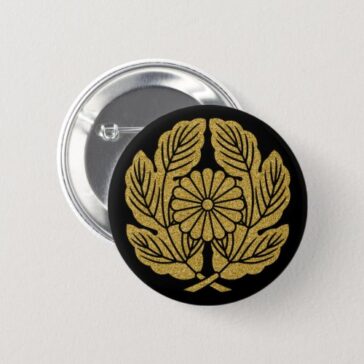
[Blagues familiales] Bouton Chrysanthèmes de Takamori Saigo
|

[Blagues familiales] Bouton Chrysanthèmes de Takamori Saigo. Ce blason représente des feuilles de chrysanthème enlacées autour d'une fleur de chrysanthème, formant un kamon. Au Japon, les blasons (kamon) désignent des symboles et des représentations graphiques liés à la vieillesse. Ce blason aurait été utilisé par Saigo Takamori. Remarque : Chrysanthème : Dans la Chine ancienne, les chrysanthèmes étaient utilisés à des fins ornementales et… Lire la suite

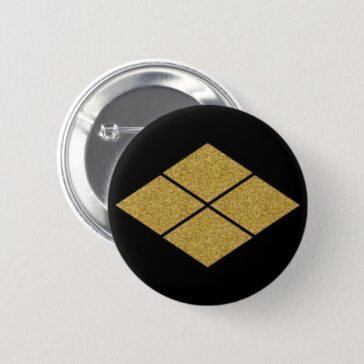
[Blagues familiales] Bouton à épingle en forme de losange Takeda
|

Il s'agit du célèbre blason de la famille Takeda Shingen. Shingen Takeda était un daimyo durant la période Sengoku. Le « Furinkazan », qui aurait figuré sur le sashimono (drapeau militaire), est également célèbre. Remarque : le hishimon (losange) serait une version stylisée du fruit du trapa japonica… Lire la suite

[Blagues familiales] Bouton en forme de losange Takeda
|

Il s'agit du célèbre blason de la famille Takeda Shingen. Shingen Takeda était un daimyo durant la période Sengoku. Le « Furinkazan », qui aurait figuré sur le sashimono (drapeau militaire), est également célèbre. Remarque : le hishimon (losange) serait une version stylisée du fruit du trapa japonica… Lire la suite

[Family Crests] Sanada’s 6 coins Button
|

This is also a famous family crest. There are various theories, but at that time, it was said that the “Sanzu River” was flowing between the world and the world, and that the ferry to cross the river required “Rokumonsen (current monetary value of about 300 yen)”. I am. The family crest also shows … Read More

[Family Crests] Sanada’s 6 coins Pinback button
|

[Family Crests] Sanada’s 6 coins Pinback button This is also a famous family crest. There are various theories, but at that time, it was said that the “Sanzu River” was flowing between the world and the world, and that the ferry to cross the river required “Rokumonsen (current monetary value of about 300 yen)”. … Read More

[Family Crests] Ryoma Sakamoto’s bellflower Button
|

Cross lines inside Kikyo (ballon flower, bellflower) Kamon. It was used Ryoma Sakamoto who succeeded in the Taisei Hokan at the end of the Edo period. note. Kikyo (ballon flower, bellflower) is Seven herbs of autumn. In the olden days, one flower of bellflower was dedicated to the gods and Buddhas to forge the … Read More

[Blagues familiales] Pièce Eiraku Bouton rond
|

[Family Crests] Eiraku coin Round Button Nobunaga Oda used the Eiraku coin (Eiraku Tsuho) design that was in circulation as a family crest as a symbol of economic power. He used it as a flag.

[Family Crests] Swallowtail butterfly Round Button
|

[Family Crests] Swallowtail butterfly Round Button It is a crest used by “Taira no Kiyomori”, the lord of the Heike clan. Nobunaga Oda began to use the “swallowtail butterfly crest” in honor of Taira’s descendants from a certain time in order to replace Seiwa Genji’s Muromachi Shogunate. note. Butterflies are creatures that grow while … Read More

[Family Crests] Ryoma Sakamoto’s bellflower round Button
|

[Family Crests] Ryoma Sakamoto’s bellflower round Button Cross lines inside Kikyo (ballon flower, bellflower) Kamon. It was used Ryoma Sakamoto who succeeded in the Taisei Hokan at the end of the Edo period. note. Kikyo (ballon flower, bellflower) is Seven herbs of autumn. In the olden days, one flower of bellflower was dedicated to … Read More

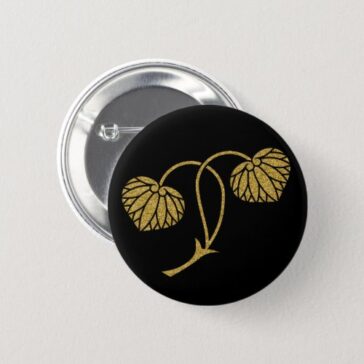
[Blagues familiales] 2 feuilles de rose trémière Bouton
|

The crest of Kamigamo Shrine in Kyoto. The 3 Hollyhock(Aoi) crest used by Ieyasu Tokugawa is said to be derived from it. note: Hollyhock(Aoi) is a perennial plant that grows naturally in forests all over the country and is a common plant. It is said that the development of the house was likened to … Read More

[Family Crests] 2 hollyhock leaves Round Button
|

[Family Crests] 2 hollyhock leaves Round Button The crest of Kamigamo Shrine in Kyoto. The 3 Hollyhock(Aoi) crest used by Ieyasu Tokugawa is said to be derived from it. note: Hollyhock(Aoi) is a perennial plant that grows naturally in forests all over the country and is a common plant. It is said that the … Read More

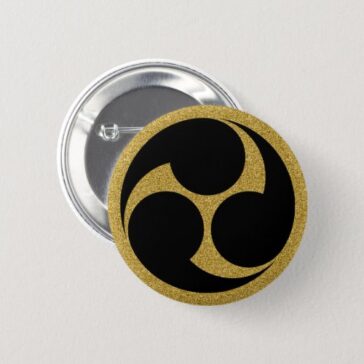
[Blagues familiales] Bouton Mitsudomoe à rotation gauche
|

Son origine est incertaine, mais il est souvent utilisé comme emblème divin. Apparu au sanctuaire Hachiman, il s'est ensuite répandu dans d'autres sanctuaires. Devenu populaire depuis l'Antiquité, il a servi à la confection d'emblèmes familiaux non spécifiés. [Emblèmes familiaux] Bouton Mitsudomoe à rotation gauche. Le nom de famille auquel… Lire la suite

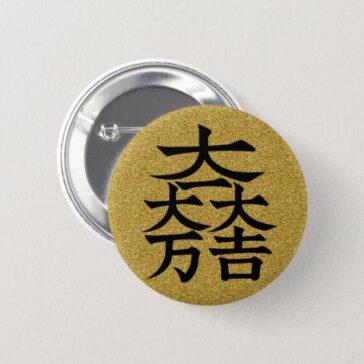
[Blagues familiales] Ishida Mitsunari Symbole Kanji sur bouton de drapeau militaire
|

Il s'agit d'un symbole kanji qui fut hissé comme drapeau de guerre par le commandant militaire Mitsunari Ishida durant la période Sengoku. Il signifie : « Si une personne agit pour tous et que tous agissent pour un, alors le monde entier connaîtra le bonheur. » [Blagues familiales] Ishida Mitsunari, symbole kanji sur drapeau militaire. Bouton

[Blagues familiales] Fleur de glycine avec bouton à épingle circulaire
|

Flowers symbol and graphics at old age. Circle with Wisteria Kamon. [Family Crests] Flowers Circle and Wisteria Pin Button Click the button below to view the inverted black-and-white version of this family crest. Wisteria Flowers Round Pin Button (inverted) Family names that have inherited this crest Amano, Fujikawa, Fujimori, Fujino, Fujiwara, Fukuo, Hoshimura, Ida, … Read More

[Blagues familiales] Deux raisins Bouton
|

Le blason à motif de grappe de raisin est un motif très rare originaire du continent. Ce blason, orné de nombreux fruits et de vignes enroulées autour, est considéré comme un porte-bonheur pour la prospérité des descendants, le mariage et les affaires. [Blason familial] Bouton à deux grappes de raisin

[Blagues de famille] Bouton d'amour Naoe Kanetsugu
|

L'inscription frontale « Ai (amour) » était apposée sur le casque porté par Kanetsugu Naoe durant la période des Royaumes combattants. Selon une théorie, il s'agirait d'un acronyme pour le Bouddha de la Guerre appelé Atago Gongen. L'Atago Gongen est un Bouddha qui combat l'ennemi avec Bishamonten. [Blagues familiales] Naoe Kanetsugu Bouton d'amour

[Blagues familiales] Roues de calèche Genji autour du bouton
|

Genji carriage wheel round Button A family crest inspired by the ancient imperial carriage. It became a family crest due to its aesthetic significance. Note that the imperial carriage is also known as the Genji carriage. It can be found by clicking the button above. The white family crest is hidden. Click the “Edit … Read More