
Home » Animal » Sloth in Kanji and Katakana as animals

La pigrizia in Kanji e Katakana come animali

creato dal designer

$0.00$1,490.00

600x600
$0.00
1920x1920
$4.80
6000x6000
$9.80
Pieno
$19.80
Pieno
$980.00
Pieno
$1,490.00
Category:

Description for Sloth

Mammalia Edentata A general term for animals belonging to the sloth family. There are 5 species in 2 genera of this family, Bradypodidae, which live mainly on trees in the dense forest areas of South America and feed on leaves and flowers.

Body length 50-64 cm, no tail, or even short. Weight 4-9 kg. The hind limbs have 3 fingers in each genus, but the forelimbs have 2 fingers in the sloth genus and 3 fingers in the sloth genus, and both the front and rear limbs have large bent claws on all fingers. Sloths that live on trees live upside down with this hook, so the long hair that covers their bodies grows from the belly to the back, contrary to normal animals.

It is sluggish on trees, moving at an average speed of 900 meters per hour, hanging and sleeping for 18 hours a day. It hangs upside down on the tree, but it becomes hungry on the ground and underwater, and it is good at swimming. Body temperature is known to be the lowest among mammals and has been observed to vary between 24-35 ° C. The long gestation period of 263 days for Linnaeus’s beetle is thought to be related to this low body temperature. One child is normal, and the lifespan is 32 years in the case of Hoffmann’s two beasts.

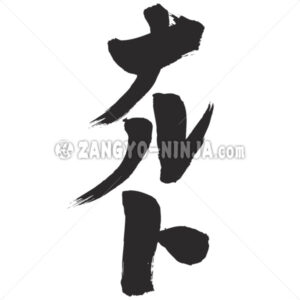
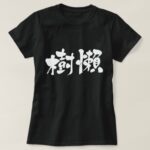
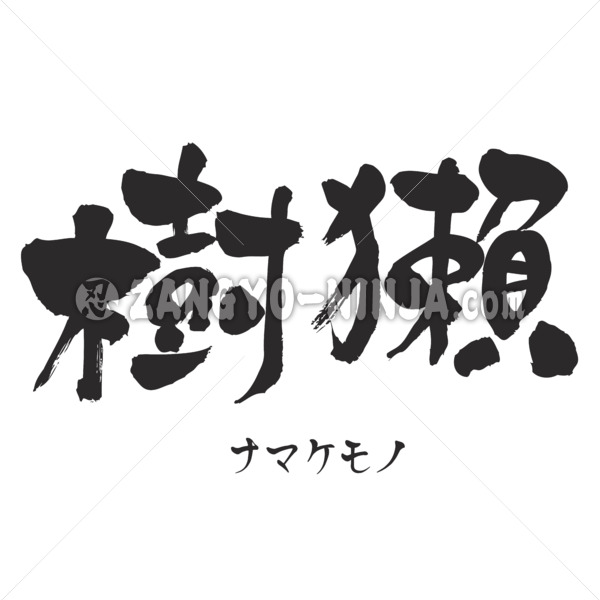
In Japanese, it is read as Namakemono.

The origin is sloth. It’s just that. In katakana, it is written as Na ma ke mo no.
In kanji:
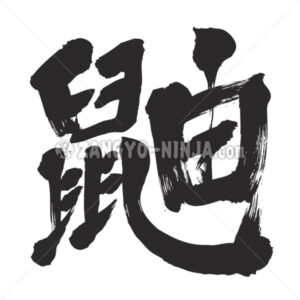
樹 (ju) → Refers to a tree growing and inhabited. Note that the kanji for “tree” (木) is the same character used for both processed wood and growing trees.
獺 (Kawauso) → Refers to an otter. It is a difficult kanji.
Dettagli tecnici AI Vector, 117.8 KB
, , , , , , ,

People also views for about Sloth

   
falco in Kanji - Zangyo-Ninja

falco in Kanji

A general term for small and medium-sized species o [...]
vettore
GRATIS~ Visualizza i dettagli
turban shell in Kanji - Zangyo-Ninja

turban shell in Kanji

Japan calls “Sa-Za-E”. A shell of Turbinidae, the t [...]
vettore
GRATIS~ Visualizza i dettagli
hentai in kanji - Zangyo-Ninja

hentai in kanji

Description for Hentai A change in form, state, eco [...]
vettore
GRATIS~ Visualizza i dettagli
Yak in Kanji - Zangyo-Ninja

Yak in Kanji

Japanese says Ya-Ku. large long-haired wild ox of T [...]
vettore
GRATIS~ Visualizza i dettagli

Opere consigliate dal creatore Aokage

Tanaka in Kanji - Zangyo-Ninja

Tanaka in Kanji

Salve, signor Tanaka. Questa è una spiegazione dell'o [...]
vettore
GRATIS~ Visualizza i dettagli
Ishida come cognome in Kanji, Katakana e Hiragana - Zangyo-Ninja

Ishida come cognome in Kanji, Katakana e Hiragana

Salve, signor Ishida. Questa è una spiegazione dell'o [...]
vettore
GRATIS~ Visualizza i dettagli

Caffè in caratteri Kanji

È una delle bevande più popolari al mondo [...]
vettore
GRATIS~ Visualizza i dettagli
Mizuki nel cognome Kanji - Zangyo-Ninja

Mizuki nel cognome Kanji

Salve, signor Mizuki. Questa è una spiegazione dell'o [...]
vettore
GRATIS~ Visualizza i dettagli
Morita in Kanji, Hiragana e Katakana - Zangyo-Ninja

Morita in Kanji, Hiragana e Katakana

Salve, signor Morita. Questa è una spiegazione dell'o [...]
vettore
GRATIS~ Visualizza i dettagli
AOKAGE
1017

Aokage

Ha vinto diversi premi d'oro e d'argento nella calligrafia giapponese (Shodo). Ama il sushi e il sashimi. Suo padre, che pratica la calligrafia fin da bambino, era un insegnante qualificato. Aokage (青景) deriva dal paesaggio blu come il mare, il cielo azzurro e limpido. E dall'ombra blu. Ombra significa ninja.

Anche le persone intelligenti come te stanno guardando