

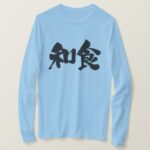
![[Kanji] Japanese food Tee Shirt](/wp-content/uploads/kanji_japanese_food_t_shirt_jg95t_1024.jpg)
[Kanji] Japanese food T-shirt
A meal that combines ingredients such as fish and vegetables that have been naturally grown in Japan using traditional methods, mainly rice and soup, pickles, and side dishes. There is no clear definition of the content of the meal, and the most basic meal is called Ichiju Sansai. This is a dish with 3 kinds of side dishes and 1 kind of soup, which is rice and pickles, 1 main dish such as fish and tempura, and 2 side dishes cooked mainly with vegetables. A lot of water is used for cooking, and it is used in combination many times from the stage where cooking methods such as boiling, steaming, and baking are used. When eating raw fish and vegetables, one of the features is that they can be finely finished using special cooking tools.
The name Japanese cuisine was used to contrast with Western cuisine by Taijiro Ishii’s “The Complete Japanese Cooking Method” published in 1898 (Meiji 31), and it is said that it has taken root. It is uncertain when the name Japanese food has been used, and it is thought that it will be even later than the name Japanese food.
In 2013 (Heisei 25), Japanese food was registered as “Japanese food-Japanese traditional food culture” in the UNESCO World Intangible Cultural Heritage. The meaning of Japanese food in this registration is a comprehensive summary of “the practice of food that Japanese people who respect nature have formed”, and has the following four characteristics. (1) A variety of foodstuffs that have been nurtured in the rich nature of the land, sea, mountains, and villages that are long from north to south, and the development of techniques and tools for cooking them. Healthy eating habits that take advantage of the delicious taste of dashi and refrain from animal fats and oils, (3) Use of vessels and furnishings, including cooking that harmonizes the beauty of nature and the transition of the four seasons with meals A culture that is closely related to food and year-round events that respect the blessings of nature, such as the aesthetic sense that appears in (4) New Year and rice planting, is inherited, and the bonds between the family and the community are protected. The registration of World Intangible Cultural Heritage includes not only cooking and cooking methods, but also family and social customs.
Japanese says Wa-Shoku.
A meal that combines ingredients such as fish and vegetables that have been naturally grown in Japan using traditional methods, mainly rice and soup, pickles, and side dishes. There is no clear definition of the content of the meal, and the most basic meal is called Ichiju Sansai. This is a dish with 3 kinds of side dishes and 1 kind of soup, which is rice and pickles, 1 main dish such as fish and tempura, and 2 side dishes cooked mainly with vegetables. A lot of water is used for cooking, and it is used in combination many times from the stage where cooking methods such as boiling, steaming, and baking are used. When eating raw fish and vegetables, one of the features is that they can be finely finished using special cooking tools.
The name Japanese cuisine was used to contrast with Western cuisine by Taijiro Ishii’s “The Complete Japanese Cooking Method” published in 1898 (Meiji 31), and it is said that it has taken root. It is uncertain when the name Japanese food has been used, and it is thought that it will be even later than the name Japanese food.
In 2013 (Heisei 25), Japanese food was registered as “Japanese food-Japanese traditional food culture” in the UNESCO World Intangible Cultural Heritage. The meaning of Japanese food in this registration is a comprehensive summary of “the practice of food that Japanese people who respect nature have formed”, and has the following four characteristics. (1) A variety of foodstuffs that have been nurtured in the rich nature of the land, sea, mountains, and villages that are long from north to south, and the development of techniques and tools for cooking them. Healthy eating habits that take advantage of the delicious taste of dashi and refrain from animal fats and oils, (3) Use of vessels and furnishings, including cooking that harmonizes the beauty of nature and the transition of the four seasons with meals A culture that is closely related to food and year-round events that respect the blessings of nature, such as the aesthetic sense that appears in (4) New Year and rice planting, is inherited, and the bonds between the family and the community are protected. The registration of World Intangible Cultural Heritage includes not only cooking and cooking methods, but also family and social customs.
Japanese says Wa-Shoku.
Informazioni su questa maglietta
Una maglietta senza colletto. Si chiama T-shirt perché, quando le braccia sono distese, ha la forma di una "T". Come molti sanno, è un capo d'abbigliamento classico che quasi tutti hanno indossato. Puoi scegliere tra T-shirt a maniche lunghe e felpe con cappuccio da uomo o da donna, e puoi scegliere la taglia e il colore che preferisci. •
T-shirt unisex, da uomo, da donna o per bambini
• Diverse taglie
• Ampia varietà di colori
• 100% cotone (miscela con poliestere a discrezione del produttore)
• Orlo a doppia cucitura su maniche e fondo
• Lavabile in lavatrice a freddo
T-shirt unisex, da uomo, da donna o per bambini
• Diverse taglie
• Ampia varietà di colori
• 100% cotone (miscela con poliestere a discrezione del produttore)
• Orlo a doppia cucitura su maniche e fondo
• Lavabile in lavatrice a freddo
Articoli di design correlati
![[Kanji] Japanese katydid T-Shirt](https://www.zangyo-ninja.com/wp-content/uploads/kanji_japanese_katydid_t_shirt_uz81u_1024-150x150.jpg)

Opere correlate (La versione di prova in formato jpg è GRATUITA!)
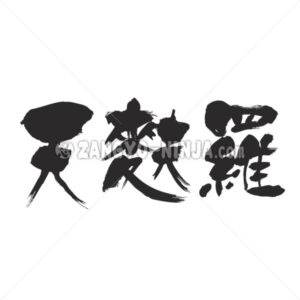
Tempura in Kanji
variabile Descrizione dei cibi in tempura: È un piatto giapponese in cui ingredienti come frutti di mare…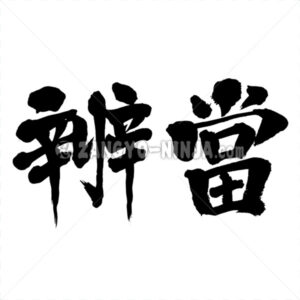
Bento in Kanji come forma di carattere antico
variabile In genere, si tratta di un pasto portatile composto da riso e contorni in un contenitore…
Sukiyaki in Kanji
variabile Sukiyaki history One of the hot pot dishes. Beef is mainly used, but there are…
Curry in Kanji
variabile Curry is readily available at any restaurant, and it has become a national dish in…
pasto semplice in Kanji
variabile It is also a must to have "one bowl of soup and one side dish"…
Shimizu in Kanji, Hiragana e Katakana include Kokorozashi
variabile Buongiorno, signor Shimizu. Questa è una spiegazione sull'origine del cognome Shimizu, che…
Curcuma in Kanji
variabile La curcuma appartiene alla famiglia dello zenzero. È caratterizzata dal suo profumo, dal suo sapore amaro,…
Potato in Kanji
variabile Description for Potato as foods In Japan, it is commonly called Jagaimo, and as you…