

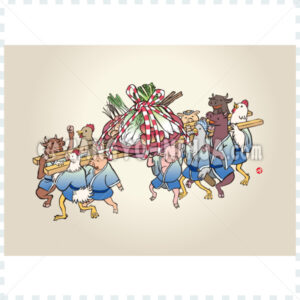
Festa da Colheita. Gado carregando o santuário portátil - Zangyo-Ninja

Esta é a segunda ilustração desenhada à mão. A primeira está aqui. Ela representa um festival da fertilidade. No Japão, festivais locais são realizados com frequência, principalmente no outono. É um festival para celebrar uma boa colheita, por isso acontece na época da colheita do arroz… Leia Mais

vetor
não avaliado $0.00$1,490.00 Selecione a licença
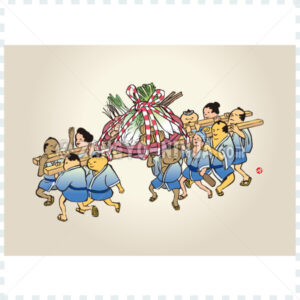
Festa da Colheita. Anões carregando um santuário portátil - Zangyo-Ninja

This is a contemporary illustration drawn in brushstroke style. In Japan, there are invisible dwarfs. There is a Japanese folktale about a dwarf called “Issunboushi” who exterminates demons. There is also a world fairy tale about “Seven Dwarfs” who save a princess in a castle. Where do these dwarfs come from and what do … Read More
vetor
não avaliado $0.00$1,490.00 Selecione a licença
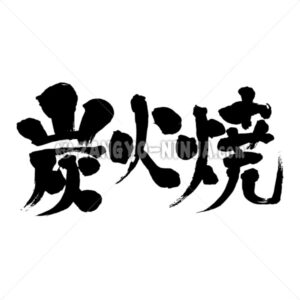
Grelhado no carvão em Kanji - Zangyo-Ninja

Um prato em que os ingredientes são grelhados em fogo aberto usando carvão vegetal como combustível. O fogo de carvão emite raios infravermelhos distantes quatro vezes mais do que o gás, e o calor radiante queima os ingredientes diretamente. No caso do gás contendo hidrogênio, ele gera vapor de água. O carvão, por sua vez, produz vapor de água .

vetor
não avaliado $0.00$1,490.00 Selecione a licença
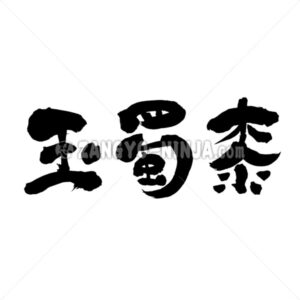
corn in Kanji - Zangyo-Ninja

An annual grass of the Gramineae family. The grains are cultivated for food and industrial raw materials, and for the entire above-ground part as feed. The stem is upright and 1 to 4 meters high. Most of the nodes are 14 to 16, and there is almost no branching. Fresh, frozen (whole form, cut … Read More
vetor
não avaliado $0.00$1,490.00 Selecione a licença
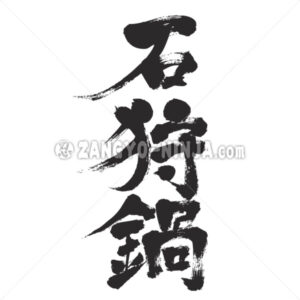
salmon and vegetable stew with miso and butter hotpod in Kanji - Zangyo-Ninja

This is a Japanese hot pot dish made with crab as a main ingredient and miso seasoned, and is a local dish of Hokkaido. Often confused with Sanpei soup using salted salmon, Ishikari Nabe uses raw salmon that is made with miso and is not salted. Japanese says “Ishi kari nabe”.

vetor
não avaliado $0.00$1,490.00 Selecione a licença
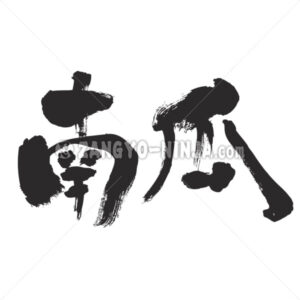
pumpkin in Kanji - Zangyo-Ninja

Description for Pumpkin Pumpkin is a general term for fruit vegetables belonging to the genus Cucurbita within the family Cucurbitaceae. While native to the Americas, the primary production areas are China, India, Ukraine, Africa. Wild species of the genus Cucurbita are distributed only in the New World, with most occurring in Mexico and Central … Read More
não avaliado $0.00$1,490.00 Selecione a licença
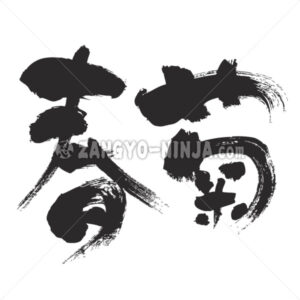
garland chrysanthemum in Kanji - Zangyo-Ninja

Asteraceae annual or biennial grass. The height is 20 to 60 cm. The leaves have deep cuts and are soft. Open yellow or white flowering head from summer to autumn. The aroma is high and is grown as food. Japanese calls “Shun Giku”.

vetor
não avaliado $0.00$1,490.00 Selecione a licença
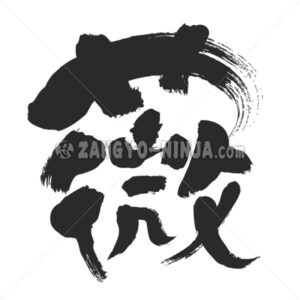
osmund in Kanji - Zangyo-Ninja

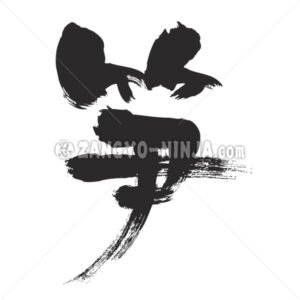
any fern of the genus Osmund: large ferns with creeping rhizomes. Eats shoots in Japan. One of the typical wild plants that makes you feel spring. It grows naturally in the mountains of Japan, and the young shoots picked in early spring are edible. In general, dried Osmund, which is a dried boiled product, … Read More
vetor
não avaliado $0.00$1,490.00 Selecione a licença
Tempura em Kanji - Zangyo-Ninja

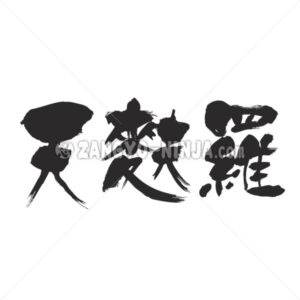
Description for Tempura foods It is a Japanese dish in which ingredients such as seafood and vegetables are wrapped in a garment mainly made of wheat flour and fried in oil. Tempura is a fast food imported from Nanban (Westerner) Tokugawa Ieyasu is known to have been very careful about his health, and it … Read More

vetor
não avaliado $0.00$1,490.00 Selecione a licença
Bamboo shoots in Kanji - Zangyo-Ninja

A young bud from the rhizome of bamboo in early summer. Several times it is covered with leather, growing grows in a few days while leaving the skin off. It is edible while it is soft. Japanese says Takenoko.
vetor
não avaliado $0.00$1,490.00 Selecione a licença
Japanese food in Kanji - Zangyo-Ninja

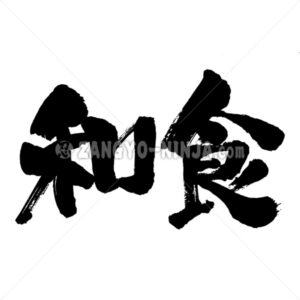
the specific foods planted/produced and well-eaten in Japan, such as fruits, vegetables, confections, snacks, etc. Japan calls Wa-Syoku.

vetor
não avaliado $0.00$1,490.00 Selecione a licença
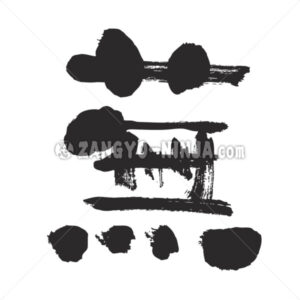
pea in Kanji - Zangyo-Ninja

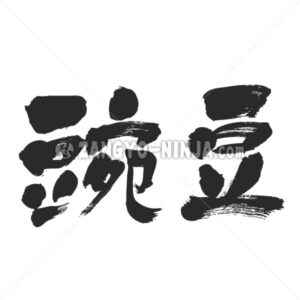
a leguminous plant of the genus Pisum with small white flowers and long green pods containing edible green seeds. Japan calls En-Do.
vetor
não avaliado $0.00$1,490.00 Selecione a licença
turnip in Kanji - Zangyo-Ninja

widely cultivated plant having a large fleshy edible white or yellow root. any of several widely cultivated plants having edible roots. root of any of several members of the mustard family. Japanese calls Kabu, Kanbura or Kaburana.

vetor
não avaliado $0.00$1,490.00 Selecione a licença
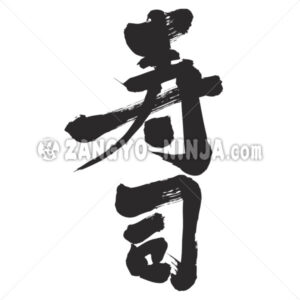
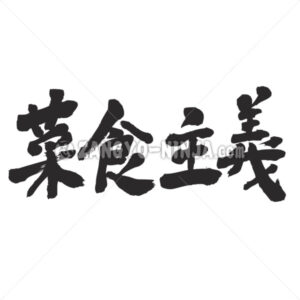
Sushi em Kanji - Zangyo-Ninja

Descrição do Sushi: Qualquer prato feito com arroz avinagrado que também contenha vegetais, especiarias, peixe ou outras iguarias. Existem diferentes tipos de "Sushi", que variam de acordo com a região. O mais comum é o "Nigirizushi", originário da região de Tóquio. O Nigirizushi consiste em pequenas bolinhas ovais de arroz temperadas com vinagre e açúcar… Leia Mais
vetor
não avaliado $0.00$1,490.00 Selecione a licença
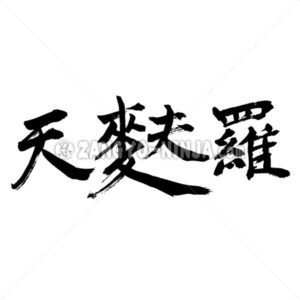
tempura written thiny in Kanji - Zangyo-Ninja

Japanese says Ten-pu-ra. Battered with water-soluble wheat flour and fried in vegetable oil. It begins in the Edo period. this is most difficult kanji. The etymology of tempura is “tempero” which means “cooking” in Portuguese and “templo” which means “heavenly day (day when birds and beasts are forbidden and eat fried fish)” in Spanish. … Read More
vetor
não avaliado $0.00$1,490.00 Selecione a licença
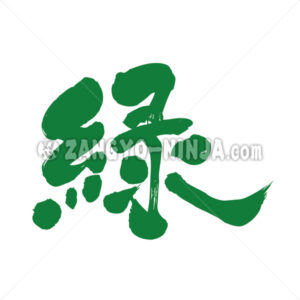
verde em kanji - Zangyo-Ninja

Esta é a cor entre o azul e o amarelo no espectro de cores. Refere-se a diversas plantas folhosas, ou às suas folhas e caules, consumidas como vegetais. É uma área de grama bem aparada ao redor do buraco em um campo de golfe. Em japonês, diz-se Midori.

vetor
não avaliado $0.00$1,490.00 Selecione a licença