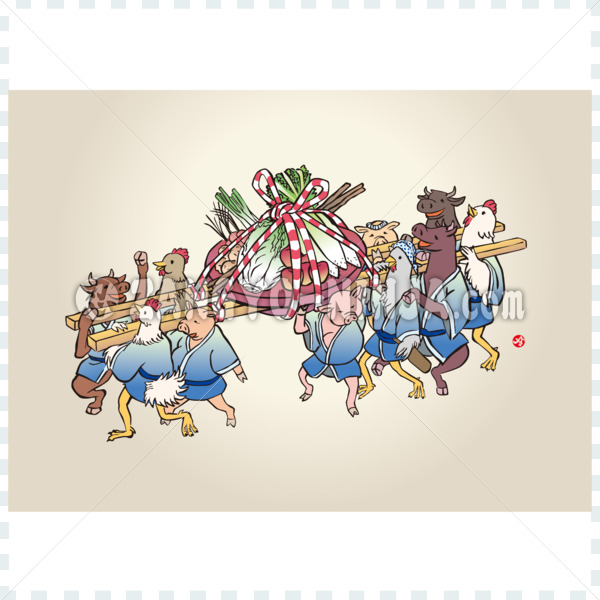
Home » Animal » Harvest Fest. Livestock carrying the portable shrine

Fiesta de la Cosecha. Ganado transportando el santuario portátil

creado por diseñador

$0.00$1,490.00

600x600
$0.00
1920x1920
$4.80
6000x6000
$9.80
Lleno
$19.80
Lleno
$980.00
Lleno
$1,490.00

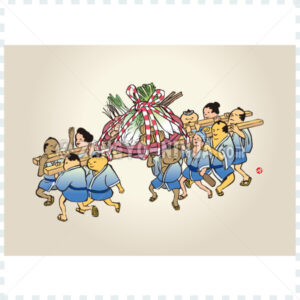
This is the second type of illustration drawn in a hand-drawn style.
The first type is here.

It signifies a fertility festival.

In Japan, local festivals are frequently held mainly in the autumn season. It is a festival to celebrate a good harvest, so it is held in the season when the rice harvest is over in regions where there were many rice farmers.
In areas where festivals are held, portable shrines are carried.
The Mikoshi is a portable shrine that is believed to carry the body of the deity or the spirit of the deity (goreidai) when the spirit of the deity travels from the head shrine to other shrine.
There are various forms of Mikoshi, including the barrel Mikoshi carried by sake barrels, the fan Mikoshi, and the Zuiki Mikoshi (a portable shrine made of taro or taro stems).

This is a scene of anthropomorphic domestic animals carrying a portable shrine.

In Japan, most people do not have a monotheistic view, but rather a polytheistic view, in which gods (or ghosts or evil spirits) are believed to dwell in all living things and even in objects that have been used for a long period of time.
In this illustration, chickens, pigs, and cows, in which so-called divine spirits dwell, bring the harvest (living things) from the fields and wish for a bountiful harvest.
These harvests are depicted as Chinese cabbage, carrots, leeks, burdocks, apples, potatoes, etc., and they are imitated as deities.
Detalles técnicos AI Vector, 1.47 MB
, , , , , , , , ,

People also views for about Harvest

   
Ichiban, primero en kanji - Zangyo-Ninja

Ichiban, primero en kanji

La palabra "top" en japonés tiene varias formas de escribirse, [...]
vector
GRATIS~ Ver detalles
Shomon Raifuku en kanji, el proverbio en hiragana. 笑門来福 - Zangyo-Ninja

Shomon Raifuku en kanji, el proverbio en hiragana. 笑門来福

La felicidad llega naturalmente a los hogares llenos de risas [...]
vector
GRATIS~ Ver detalles

Obras recomendadas por el creador aokimono

Abel y Aibel en Kanji con escudo (fuente Maru-yose) - Zangyo-Ninja

Abel y Aibel en kanji con escudo (fuente Maru-yose)

Ambos son “abel” y “aibel”. Estas obras son fonéticas [...]
vector
GRATIS~ Ver detalles
iCe en bicaligrafía como diseño tradicional japonés - Zangyo-Ninja

iCe en bicaligrafía como diseño tradicional japonés

Descripción iCe y Natsugori(夏氷) Este diseño es un diseño [...]
vector
GRATIS~ Ver detalles
Excelente en inglés e hiragana - Zangyo-Ninja

Excelente en inglés e hiragana

Esta es una obra en la que la palabra hiragana “すげー” y [...]
vector
GRATIS~ Ver detalles
Monte Fuji - Zangyo-Ninja

Monte Fuji

El monte Fuji es la montaña más alta de Japón. La más alta [...]
vector
GRATIS~ Ver detalles
vivo en inglés, kanji e hiragana - Zangyo-Ninja

vivo en inglés, kanji e hiragana

Esta es una caligrafía escrita utilizando un método llamado [...]
vector
GRATIS~ Ver detalles
Belleza en inglés, kanji e hiragana - Zangyo-Ninja

belleza en inglés, kanji e hiragana

Esta es una obra en la que la palabra japonesa “美し [...]
vector
GRATIS~ Ver detalles
Foto de avatar
17

aokimono

El tema central de mi vida es el Japón alternativo. Esta letra A es el símbolo actual del Aokimono. Se asemeja a la primera letra de los 51 caracteres hiragana, "あ". Además, "A" es la primera letra del alfabeto. Es uno de los estilos alternativos del Japón, llamado "Bicaligrafía", en el que escribo japonés en inglés e inglés en japonés.

Las personas que son alegres como tú también están mirando