Home » Places & Landmark » Japan » Akita in Kanji, Katakana and Hiragana as written vertically

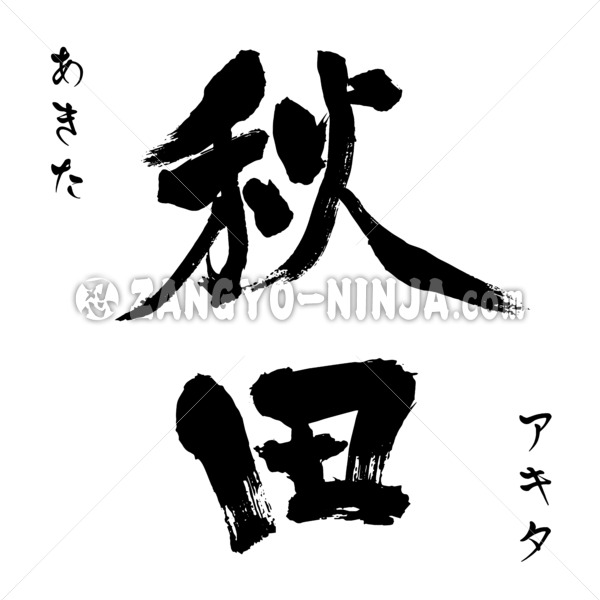
Akita in Kanji, Katakana and Hiragana as written vertically

créé par un designer

$0.00$1,490.00

600x600
$0.00
1920x1920
$4.80
6000x6000
$9.80
Complet
$19.80
Complet
$980.00
Complet
$1,490.00

The Etymology of Akita

The name derives from the ancient term “Agita.” It is the place visited by Abe no Hirafu, who appears in the *Nihon Shoki* (Chronicles of Japan). The prevailing theory is that the name originates from Ainu or ancient Japanese words meaning “a high place” or “a piece of land jutting out” (age-ta). Later, the Chinese characters for “Akita” were assigned to this name.
This is widely accepted as the etymology of the current Tohoku region of Japan, specifically Akita Prefecture.

One of the Japanese Surnames

This is a lineage of samurai and noble families that took the name from the place name “Akita” in Dewa Province (present-day Akita Prefecture) or from the official title “Akita-no-shōsuke” held by the Andō clan, who governed the region. There are also theories that it derives from “Akita” (飽田), referring to rice crops in low-lying wetlands, or that the characters for ‘Akita’ were applied to a place name meaning “high ground.”
There are approximately 37,000 people with this surname nationwide.

Hachiko’s breed is the Akita Inu (dog)

Hachiko, the dog from Shibuya who became famous through a Hollywood movie, is an Akita Inu. This relatively large breed is most commonly red in color, followed by brindle and white, and is characterized by a tail that curls upward. This breed is also named “Akita.”

Explication de cette calligraphie

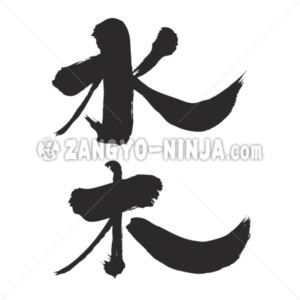
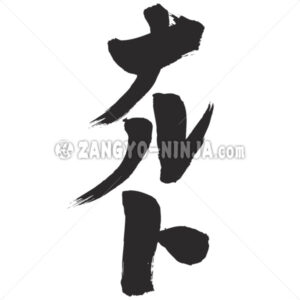
The left side is written vertically in hiragana, the center consists of two kanji characters, and the right side is written vertically in katakana.
The kanji character “秋” (Aki) represents “autumn” in the four seasons of Japan (“spring, summer, autumn, winter”), and “田” (Ta) means “rice paddy.”
Détails techniques AI Vector, 183.62 KB
, ,

People also views for about Akita

   
Mizuki dans le nom de famille Kanji - Zangyo-Ninja

Mizuki en kanji de nom de famille

Bonjour, Monsieur Mizuki. Voici une explication du ou [...]
vecteur
GRATUIT~ Afficher les détails
Tanaka en Kanji - Zangyo-Ninja

Tanaka en kanji

Bonjour, Monsieur Tanaka. Voici une explication du ou [...]
vecteur
GRATUIT~ Afficher les détails
USA (États-Unis d'Amérique) en Kanji - Zangyo-Ninja

USA (États-Unis d'Amérique) en kanji

Les États-Unis d'Amérique (USA), communément appelés [...]
vecteur
GRATUIT~ Afficher les détails
Enoshima en Kanji, Katakana et Hiragana - Zangyo-Ninja

Enoshima en Kanji, Katakana et Hiragana

Qu'est-ce qu'Enoshima ? Une île située dans le nord-est [...]
vecteur
GRATUIT~ Afficher les détails
Mont Takao en Kanji, Katakana et Hiragana - Zangyo-Ninja

Le mont Takao en kanji, katakana et hiragana

Le mont Takao, une montagne récompensée par trois étoiles Michelin [...]
vecteur
GRATUIT~ Afficher les détails

Œuvres recommandées par le créateur Aokage

Café en kanji

C'est l'une des boissons les plus populaires au monde [...]
vecteur
GRATUIT~ Afficher les détails
Morita en Kanji, Hiragana et Katakana - Zangyo-Ninja

Morita en kanji, hiragana et katakana

Bonjour, Monsieur Morita. Voici une explication du ou [...]
vecteur
GRATUIT~ Afficher les détails
Ichiban, premier en Kanji - Zangyo-Ninja

Ichiban, premier en Kanji

Le mot « top » en japonais s'écrit de différentes manières, [...]
vecteur
GRATUIT~ Afficher les détails
Shomon Raifuku en Kanji, le proverbe en Hiragana. 笑門来福 - Zangyo-Ninja

Shomon Raifuku en Kanji, le proverbe en Hiragana. 笑門来福

Le bonheur s'installe naturellement dans les foyers emplis de rires [...]
vecteur
GRATUIT~ Afficher les détails
Gros buveur en Kanji - Zangyo-Ninja

Grand buveur en kanji

Un gros buveur est quelqu'un qui tient bien l'alcool [...]
vecteur
GRATUIT~ Afficher les détails
shinobi en Kanji - Zangyo-Ninja

shinobi en kanji

Les kanjis japonais pour Nin, Shinobu et Shinobi sont [...]
vecteur
GRATUIT~ Afficher les détails
AOKAGE
1032

Aokage

Il a remporté plusieurs médailles d'or et d'argent en calligraphie japonaise (Shodo). Il adore les sushis et les sashimis. Ayant pratiqué la calligraphie depuis son enfance, son père était professeur qualifié. Aokage (青景) évoque les paysages bleus, comme la mer et le ciel d'un bleu limpide, ainsi que l'ombre bleue. L'ombre symbolise un ninja.

Des gens bien comme vous regardent aussi