
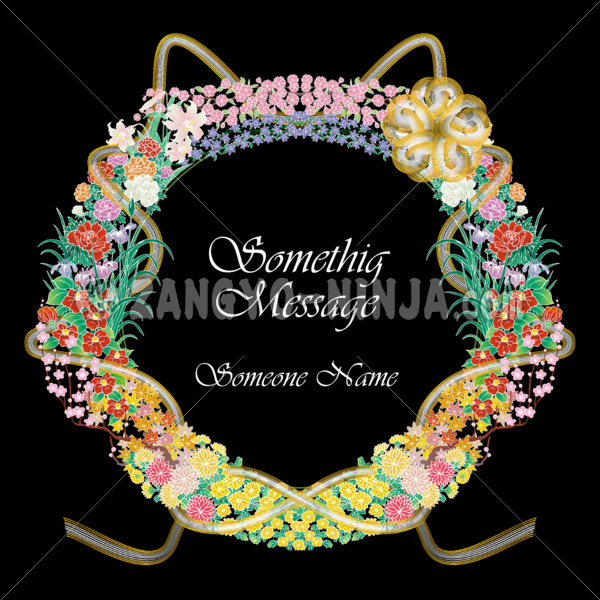

Flowers of the four seasons in Japan are depicted in a Yuzen style ring and wrapped with Mizuhiki, which is meant to be elegant and prestigious.
This Mizuhiki is in the shape of a “Kemomimi”.
Description for this flower ring design
What’s Yuzen
Yuzen is an abbreviation for yuzen dyeing, a traditional technique for dyeing kimonos, and dyed kimonos are called yuzen kimonos.
Yuzen-dyed kimonos are used for special occasions such as coming-of-age ceremonies and weddings.
About Mizuhiki
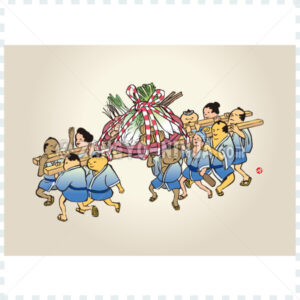
Mizuhiki is a decorative string used on the front of Japanese congratulatory and non-celebratory envelopes, mainly for Yuinou ceremony (Yuinoushiki),
MIZUHIKI is a decorative string used for the front of congratulatory and non-celebratory bags, and is mainly used for Yuinou ceremony (Yuinoushiki), front cover of gifts, and New Year’s decorations.
Mizuhiki crafts are available in a wide variety of colors and types, and are used to make cranes and turtles, pine trees, bamboo and plum, treasure ships, and other ornaments.
These days, Mizuhiki is used in a wide variety of applications, such as ornaments, accessories, and interior decorations.
There are certain rules for the number of strings and colors.
What’s Yuinou ceremony (Yuinoushiki)
A yuinou ceremony is a traditional Japanese ceremony in which a man and a woman confirm and consummate their engagement between the two families. The purpose of the ceremony is to strengthen the bond between the two families by giving each other money and goods as proof of the betrothal.
What’s Kemomimi
A term used mainly on the Internet to refer to the ears of a beast. Rather than referring to the actual ears of a beast, it is more often used to refer to the ears of a humanoid character in anime and manga that have or have grown on them.
MIZUKI is incorrect. The correct term is MIZUHIKI.
Until recently, there have been a series of strange search terms, and after researching various sources, I found that decorative cords used for gifts, gift envelopes, and condolence envelopes are called MIZUHIKI, while MIZUKI is a common word used in Japanese names and surnames.