
The Fujiwara surname is the ancestral root for about half of all Japanese people.
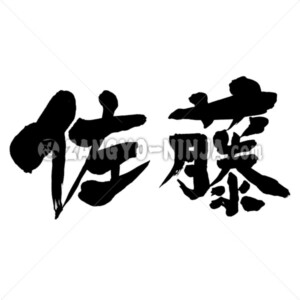
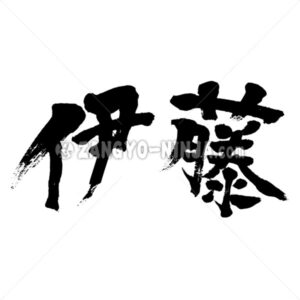
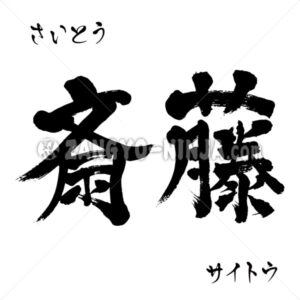
There are approximately 280,000 people with the Fujiwara surname throughout Japan, equivalent to the population of Newark, New Jersey. While the Fujiwara surname’s share of 0.22% is not large, a notable point is that many surnames like Sato, Saito, Ito, Kato, Goto, Mutoh, Kondo, Ando, Oto, Endo, Kudo, Eto, Fujii, Fujita, Fujimoto, Fujisawa, and Fujioka, as well as surnames without “fuji,” originated from Fujiwara.
This means that tracing their ancestry back, most Japanese people are connected to this surname.
Fuji (藤) is the name of a flower.
It is a familiar flower to Japanese people. It is a deciduous vine native to Japan, typically blooming from mid-April to mid-May. Its characteristic feature is the drooping clusters of flowers, which come in diverse colors like purple, white, pink, and yellow, and emit a beautiful fragrance. It has been cherished in Japan since ancient times, with famous viewing spots found throughout the country.
Its long lifespan evokes the concept of “immortality” (read as fushi → fuji), making it considered auspicious.
The origin of the Fujiwara surname comes from a surname granted by Emperor Tenji.
The main origin is that in the 8th year of Emperor Tenji’s reign (669 AD) during the Asuka period, Nakatomino Kamatari, a key figure in the Taika Reform, was granted the surname Fujiwara by Emperor Tenji. This was in reference to the land of Fujiwara in Takachiho District, Yamato Province (present-day Kashihara City, Nara Prefecture = site of Fujiwara-kyo).
As mentioned earlier, wisteria trees have long lifespans. Another theory, the topographical theory, suggests the surname Fujiwara was adopted because the family resided in a land where wisteria flowers spread widely.
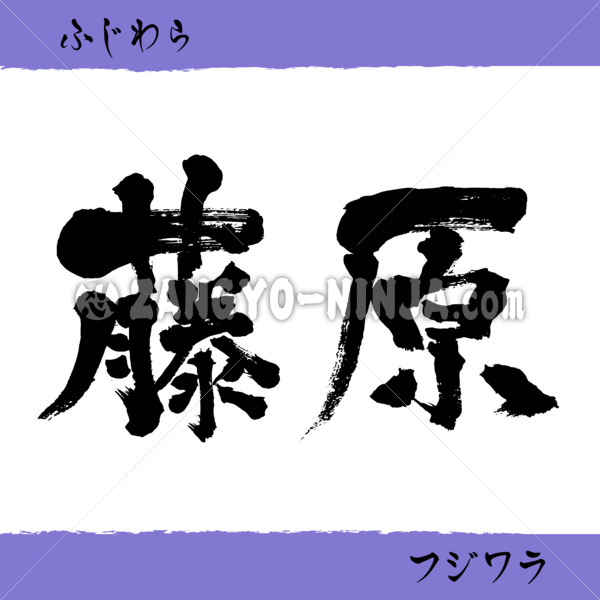
Explanation of this calligraphy
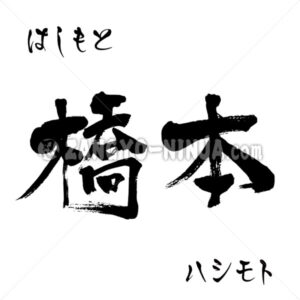
The top row is in hiragana, the middle row in kanji, and the bottom row in katakana, all written horizontally.