
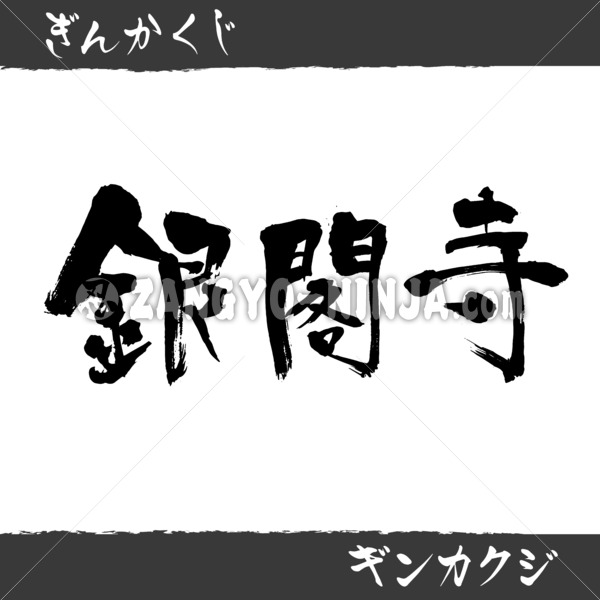

Description for Ginkaku-ji
It is called Higashiyama Jishoji Temple and is one of the sub-temples of Shokokuji Temple. It is said that the name originated from the fact that it was called Ginkaku-ji Temple in contrast to Kinkaku-ji Temple.
Why is it called “Silver Pavilion” when it’s not silver?
Kinkaku-ji Temple is covered in flashy and glittering gold leaf. In contrast, Ginkaku-ji Temple does not give off any silver color at all. Many people may wonder, “Why is it called Ginkaku-ji Temple when it’s not silver?”
There are several theories, but one of the most plausible is that it was named to contrast with the Kitayama Palace, also known as Kinkaku-ji Temple, which was the center of Kitayama culture, while Higashiyama Palace, the center of Higashiyama culture, was called Ginkaku-ji Temple.
The charm of the national treasure “Silver Pavilion/Kannon-den”
The “Kannon-den” with its cedar-shingle roof is a two-story pavilion modeled after the Shari-den of Kinkaku-ji Temple and the Ruri-den of Saiho-ji Temple.
While the Kinkaku-ji Temple is lavishly covered in gold leaf, the Ginkaku-ji Temple may seem lacking in opulence. The charm of the Ginkaku-ji Temple, a representative structure of the Higashiyama culture that flourished in the late Muromachi period, is said to be difficult for children to understand, but becomes more apparent as one grows older.
If you can appreciate the atmosphere of a typical Kyoto Japanese garden, you are considered a true connoisseur of Japan.
Work description
The top row is in hiragana, the middle row is in kanji, and the bottom row is in katakana.