
Japan is the world’s only nation with a continuous history spanning over 2,000 years.
Its origins trace back to the accession of Emperor Jimmu, the first emperor, in 660 BC. This account, recorded in the Nihon Shoki and Kojiki, is based on myths and legends. Because this imperial system has endured for over 2,000 years, Japan is considered the world’s oldest existing nation.
Historically, the name changed from “Wa” to “Nihon,” but the continuity of the imperial system proves its unbroken existence. Even during the Edo period, the system persisted because the reigning emperor relinquished only political power.
Furthermore, the notion that the imperial system ended after Japan’s defeat in World War II is a misconception. Under the Japanese Constitution, the Emperor became a symbolic figure, meaning the system itself continues.
Reasons Japan has endured as a nation to the present day.
Surrounded by sea on all sides, Japan occupies a position resistant to external invasion. This has been a key factor supporting Japan’s stability.
While possessing a national character that “values harmony,” Japan experienced a history marked by frequent conflict prior to the Edo period. Thus, though not inherently belligerent, it can be considered a nation whose disposition—whether authoritarian or gentle—has fluctuated depending on the era and the influence of its rulers.
Regarding the Origin of Japan’s Name
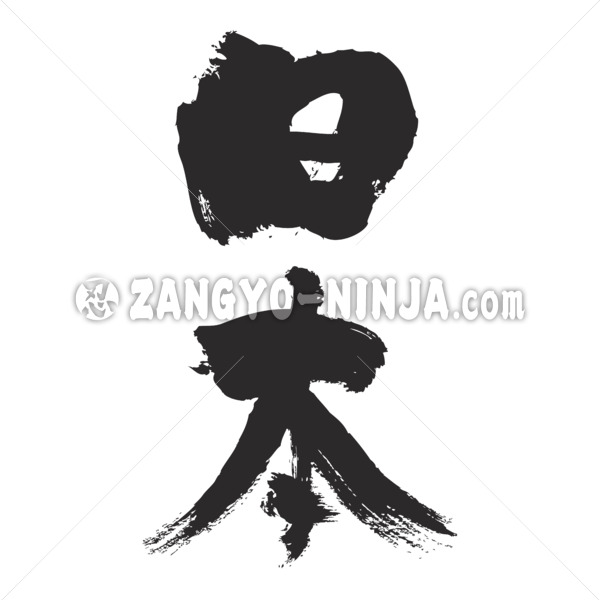
In Japanese, Japan is read as “Nippon” or “Nihon.” The first kanji character “日” (hi) refers to the sun, while “本” (hon) means “book,” but also carries the meaning of ‘origin’ or “fundamental.” Thus, it signifies the place where the sun rises. From the perspective of Western countries, Japan, being the easternmost nation, truly lives up to its name, doesn’t it?
One Japanese Family Name
Approximately 150 people in Japan bear the surname “Nihon.” This surname is extremely rare. It’s akin to someone in the United States having the surname “United States.”
However, since kanji characters have multiple readings, some people read it as “Hinomoto” rather than just ‘Nippon’ or “Nihon.”


![[Kanji] Japanese katydid T-Shirt](https://www.zangyo-ninja.com/wp-content/uploads/kanji_japanese_katydid_t_shirt_uz81u_1024-150x150.jpg)