

Shibuya exists both as a place name and as a surname.
Shibuya as a place name (Tokyo)
A ward located in the southwest of Tokyo’s 23 wards. In 1932 (Showa 7), the three towns of Shibuya, Sendagaya, and Yoyohata in Toyotama District merged to form Shibuya Ward.
Regarding the station itself, in March 2013, the Tokyu Toyoko Line Shibuya Station relocated to the basement of Shibuya Hikarie near the East Exit and began mutual direct service with the Tokyo Metro Fukutoshin Line. This enabled direct service from the Tokyu Toyoko Line via the Fukutoshin Line to the Seibu Yurakucho Line, Ikebukuro Line, and Tobu Tojo Line.
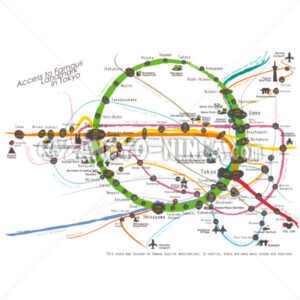
Additionally, spots like Center Street, 109, and the Scramble Crossing remain popular tourist destinations.
Shibutani as a Place Name (Japan)
・A place name in Takaoka City, Toyama Prefecture. Located at the northeastern foot of Mt. Futagami, facing Toyama Bay.
・An old name for the area between Kiyomizu Mountain and Amida Peak in Higashiyama Ward, Kyoto City.
・A place name in Inawashiro Town, Yama District, Fukushima Prefecture.
Shibuya or Shibutani as a surname
The most widely accepted theory traces its roots to samurai who lived in “Shibuya Manor” in Sagami Province during the Kamakura period. It is said that when they acquired land, they altered the ‘tani’ (valley) in the name of the valley-like area to “shibu.” There are also multiple theories regarding the origin of the Shibuya place name. One suggests it was named by the Shibuya clan residing in Sagami Province, while another proposes it evolved from “Shioya” (salt valley), a name for an inlet.
Approximately 90,000 people nationwide bear the surname Shibuya or Shibutani, ranking 226th in surname popularity.
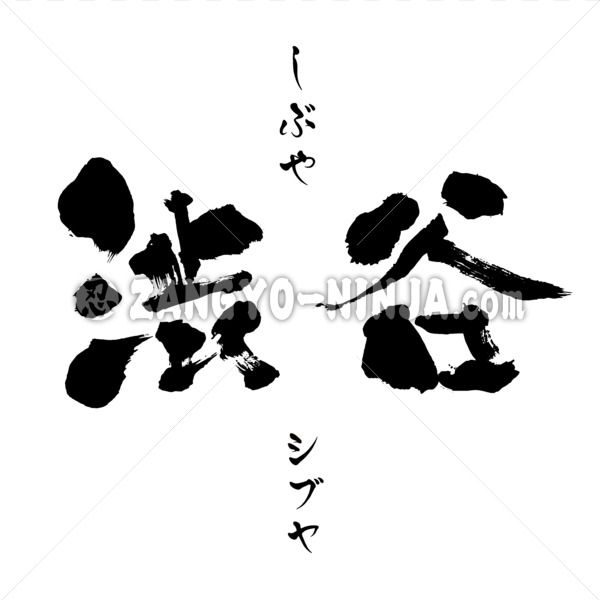
Explanation of this calligraphy work
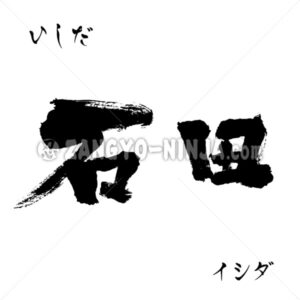
The center displays the kanji characters. Above the small vertically written characters, arranged as if crossed, are hiragana, and below are katakana.