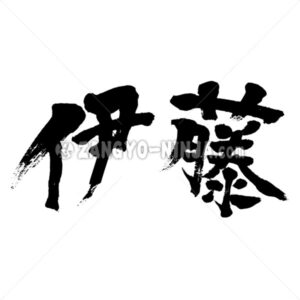

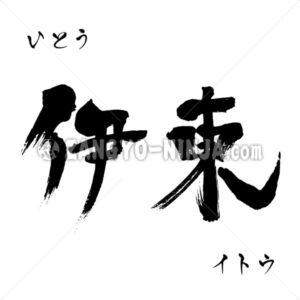
Ito in Kanji (include wisteria in kanji) - Zangyo-Ninja

It is the fifth most common surname in Japan. The surname Ito was adopted by descendants of Fujiwara no Hidesato, a warrior of the Fujiwara clan descended from Fujiwara no Kamatari (614–69), a senior minister of Emperor Tenji, the 38th emperor. They primarily took the name Ito by combining the first kanji character “伊” … Read More

vector
not rated $0.00$1,490.00 Select license
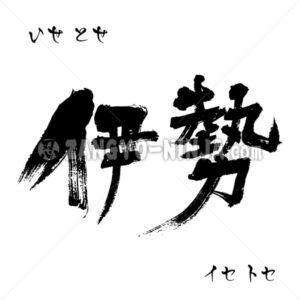
Ise, Tose in Kanji, Katakana and Hiragana - Zangyo-Ninja

Ise is one of the regional names. It is an abbreviation for Ise Province (Ise no Kuni), one of the ancient provincial divisions of Japan under the Ritsuryō system. It corresponds to most of present-day Mie Prefecture. It has been developed since ancient times as the location of Ise Grand Shrine. Ise is also … Read More
vector
not rated $0.00$1,490.00 Select license
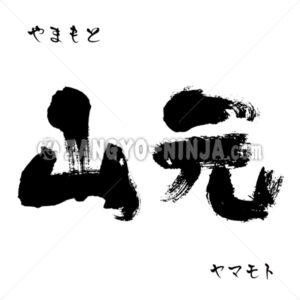
Yamamoto in Kanji, Katakana and Hiragana - Zangyo-Ninja

This is another surname with the same pronunciation but different kanji characters. Unlike the common Yamamoto in Japan (where the second character is “本” meaning “book”), this one uses “元” meaning ‘origin’ or “source.” Its origin is said to be primarily from the area around Okinawa, where the Ryukyu Kingdom once existed, extending to … Read More

vector
not rated $0.00$1,490.00 Select license
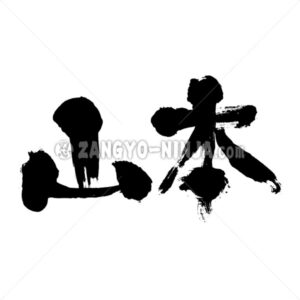
Yamamoto in Kanji - Zangyo-Ninja

It refers to the “foot of the mountain” and is named as a place name in such a place. And the house that settled in the Yamamoto place name gave the surname Yamamoto. 4th place Representative of place name surname along with Tanaka surname. Yamamoto is the 7th most common Japanese surname.

vector
not rated $0.00$1,490.00 Select license
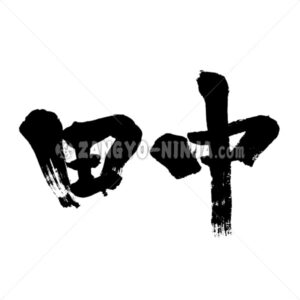
Tanaka in Kanji - Zangyo-Ninja

Tanaka is the 4th most common Japanese surname in Japan. The etymology is for rice fields and cultivation. The surname “Tanaka” originates from geographical features or place names such as “in the middle of rice fields” or “near rice fields.” It spread widely across Japan, particularly in regions where rice cultivation flourished, resulting in … Read More

vector
not rated $0.00$1,490.00 Select license
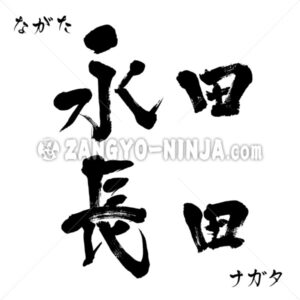
Nagata in 2 types Kanji, Katakana and Hiragana - Zangyo-Ninja

There are two types of kanji for this surname. Their origins seem to differ depending on the era and location. Origin of this surname It is generally thought to derive from words meaning “endlessly spreading rice fields” or “long rice fields,” making it a relatively common surname widely distributed throughout Japan. This refers to … Read More

vector
not rated $0.00$1,490.00 Select license
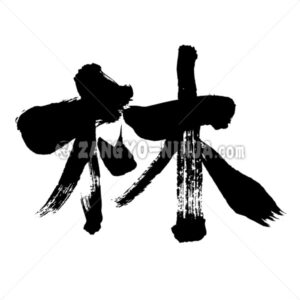
Hayashi in Kanji - Zangyo-Ninja

Japanese said “Hayashi” in a character Kanji. The etymology is “Hayasu”, and the conjunctive form of the verb “Hayasu” is a noun. “Hayasu” is to grow. The intention to prosper and grow. In other words, “Hayashi” is a place where trees are grown. It is also said to be a surname that originated from … Read More

vector
not rated $0.00$1,490.00 Select license
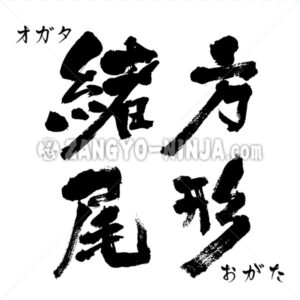
Ogata in 2 types Kanji, Katakana and Hiragana - Zangyo-Ninja

There are two types of kanji for this surname. Their origins seem to differ depending on the era and location. Origin of this surname Originating from Ogata-cho, Bungo-Ono City, Oita Prefecture. A place name recorded during the Nara period. It is said to have begun when Ōmiwa no Yoshiomi entered Ogata-go in 886 (Ninna … Read More

vector
not rated $0.00$1,490.00 Select license
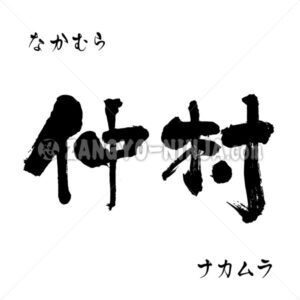
Nakamura in Kanji, Katakana and Hiragana - Zangyo-Ninja

This is another surname with the same pronunciation but different kanji characters. Unlike the common Japanese Nakamura (where the first character is “中” meaning center), this one uses “仲” meaning harmony or friendship. Its primary origin is in Okinawa, where the Ryukyu Kingdom once existed. A branch of the Ryukyu royal family bore the … Read More

vector
not rated $0.00$1,490.00 Select license
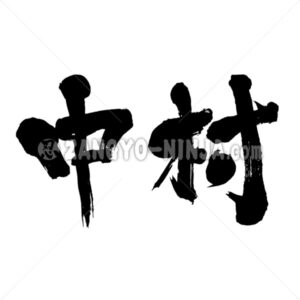
Nakamura in Kanji as Japanese family name - Zangyo-Ninja

Rice cultivation was introduced to Japan during the Yayoi period. After that, if rice cultivation developed and the number of rice fields increased, the number of villages increased in various places, and the central village was Nakamura. Then, depending on the direction of the newly created village, place names such as Higashimura, Nishimura, Ichimura, … Read More

vector
not rated $0.00$1,490.00 Select license
Date in Kanji, Katakana and Hiragana - Zangyo-Ninja

This is not about the date indicating a specific time and date, but rather an explanation of the Japanese word “Date.” The meaning of this word as “Date” To flaunt one’s spirit or chivalry. Also, the manner of doing so. To wear flashy clothing or behave ostentatiously to attract attention. To put on airs. … Read More

vector
not rated $0.00$1,490.00 Select license
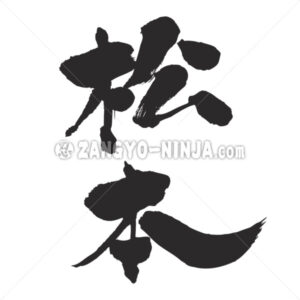
Matsumoto in Kanji - Zangyo-Ninja

1. It is a city located in the center region of Nagano prefecture. 2. Matsumoto is the 15th most common Japanese surname. There are about 620,000 people in Japan. It is as large as the population of Portland, Oregon. The most popular existing castle is Matsumoto Castle. It is located in Matsumoto City, also … Read More
vector
not rated $0.00$1,490.00 Select license
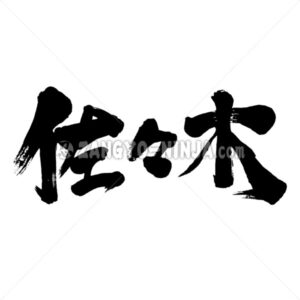
Sasaki in Kanji - Zangyo-Ninja

The etymology is “small saki” (protruding small terrain) as a place name. Sasaki is the 13th common Japanese surname. Etymology of the Sasaki surname Originated from the area near Sasaki Shrine (formerly Sasaki) in Jorakuji, Azuchi-cho, Omihachiman City, Shiga Prefecture. This place name was recorded in the Nara period. The same place was in … Read More

vector
not rated $0.00$1,490.00 Select license
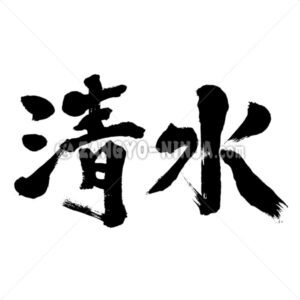
Shimizu in Kanji - Zangyo-Ninja

Shimizu is the 20th most common Japanese surname. Shimizu means “the place where Shimizu springs”. Inoue is an artificial water source, while Shimizu is a natural water source. Therefore, it is thought that there are many place names in the mountains and near the mountains.

vector
not rated $0.00$1,490.00 Select license
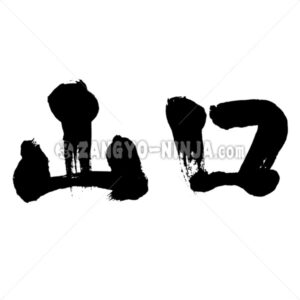
Yamaguchi in Kanji - Zangyo-Ninja

Yamaguchi has various meanings. Meaning of Yamaguchi as a noun The entrance to a mountain. The gateway to a mountain. In falconry, the act of first entering the hunting ground to begin the hunt. Also, that location. The entrance to the hunting ground. The first sign or indication of something. A woodcutter beginning to … Read More

vector
not rated $0.00$1,490.00 Select license
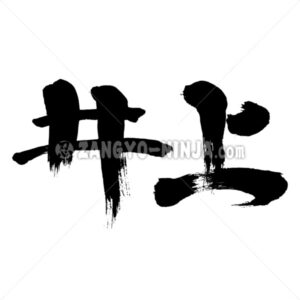
Inoue in Kanji - Zangyo-Ninja

Inoue is the 16th most common Japanese surname. The etymology is on the well. Around the well. Since the well was an important base of life in ancient times, it is said that it became widespread as a person who manages it.

vector
not rated $0.00$1,490.00 Select license
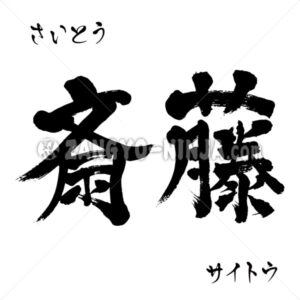
Saito in Kanji, Katakana and Hiragana - Zangyo-Ninja

One of the common surnames in Japanese. Its origin dates back to the Heian period when Fujiwara no Toshihito’s son, who was appointed as the head of the Saikyū (Sacred Palace Maiden) at Ise Shrine, adopted the name “Saito” by combining the “Sai” from ‘Saikyū’ and the “Fuji” from the Fujiwara clan. Since the … Read More

vector
not rated $0.00$1,490.00 Select license
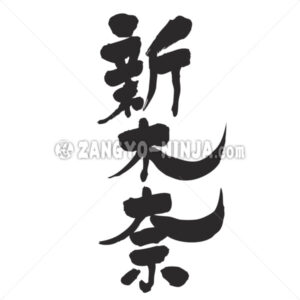
Alakina in Kanji - Zangyo-Ninja

This used as a phonetic symbol rather than for its meaning.

vector
not rated $0.00$1,490.00 Select license
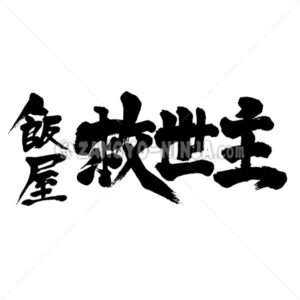
Restaurant the Messiah in Kanji - Zangyo-Ninja

This is a fictional store name. The vertical kanji characters on the left side, “飯屋,” refer to a restaurant that serves rice dishes, a place where the general public can eat, and is called “meshiya.” The horizontal kanji on the right, “救世主,” means the name of the store. In Japanese, it is called “kyuseishu,” … Read More

not rated $0.00$1,490.00 Select license
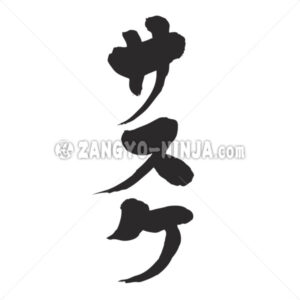
Sasuke in katakana - Zangyo-Ninja

Sasuke a character for a video game Ninja Master’s Sasuke Uchiha, a character in Naruto media Sarutobi Sasuke, a character in Japanese children’s stories. Sasuke or NinjaRed, one of several main characters in the Ninja Sentai Kakuranger television series.

vector
not rated $0.00$1,490.00 Select license
Hasebe in Kanji, Katakana and Hiragana - Zangyo-Ninja

Hasebe is one of the surnames used for people’s names. The most widely accepted theory regarding the origin of this surname is that it was given to people who managed the land allotted for the livelihood of Emperor Yūryaku (c. 456–479 AD) or who served at the Imperial Palace performing duties such as guarding … Read More

vector
not rated $0.00$1,490.00 Select license
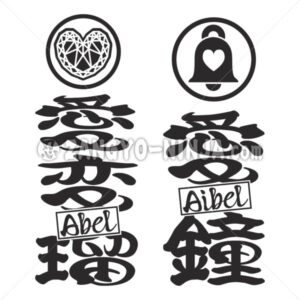
Abel and Aibel in Kanji with crest (Maru-yose font) - Zangyo-Ninja

Both are “abel” and “aibel.” These works are phonetic translations of names converted into kanji. Regarding the left work “愛” means love. “変” means transformation. “瑠” signifies a blue gemstone. It represents someone who transforms love into a blue gemstone. The upper part designs these kanji meanings as a family crest-style mark. Regarding the … Read More
vector
not rated $0.00$1,490.00 Select license
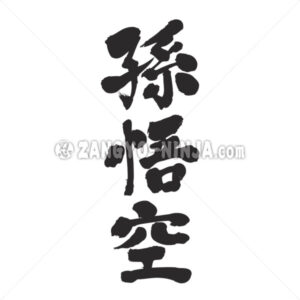
Son Goku in Kanji - Zangyo-Ninja

A monster monkey that appears in a Chinese feature novel “Saiyuki”. It was born from stone, learned the art of change and the art of Kintoun and made threatening heaven, and it was taken over by Nyorai (Budda). After that, he was rescued by Genjo Sanzo who would like to take a script to … Read More

vector
not rated $0.00$1,490.00 Select license
Takanashi in Kanji, Katakana and Hiragana - Zangyo-Ninja

Takanashi is one of the surnames used as a family name. People with this surname are extremely rare, with only a few dozen individuals nationwide in Japan. It is believed to have originally been written with the kanji characters for “Takashi” (高梨). It is a distinguished family name originating from the Inoue clan, descendants … Read More
vector
not rated $0.00$1,490.00 Select license
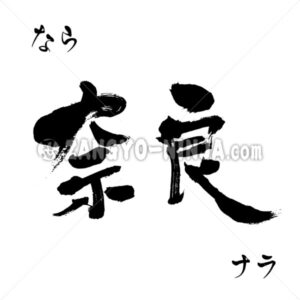
Nara in Kanji, Katakana and Hiragana - Zangyo-Ninja

Abbreviations for Prefecture and City Names A prefecture occupying roughly the central part of the Kinki region. Located near the center of Japan, the Nara Basin in the northern part of the prefecture was celebrated throughout the Asuka and Nara periods as the “heart of the nation” and the “land of plenty,” flourishing as … Read More

vector
not rated $0.00$1,490.00 Select license
Ueno in Kanji, Katakana and Hiragana - Zangyo-Ninja

Which Ueno do you want to know about? One is Ueno as a place name. Japan’s most famous Ueno is located in Taito Ward, Tokyo. It’s the subcenter of Ueno, centered around the town name or Ueno Station. Adjacent to Ueno Station, Ueno Park features art museums, history museums, Shinobazu Pond, temples with five-story … Read More
vector
not rated $0.00$1,490.00 Select license
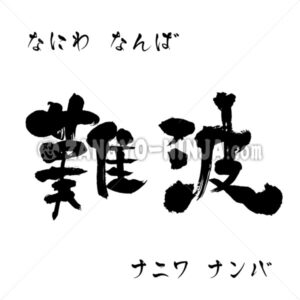
Naniwa, Namba in Kanji, Katakana and Hiragana - Zangyo-Ninja

Generally referring to Osaka, but the kanji and readings vary by era and region. Naniwa An ancient name for present-day Osaka City and its surrounding areas. Also written as “浪速” or “浪華”. Before the Taika Reform, it flourished as a key maritime transportation hub. Notably, since the tributary missions from the Three Kingdoms of … Read More

vector
not rated $0.00$1,490.00 Select license
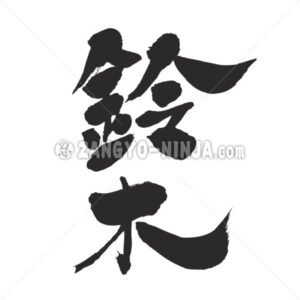
Suzuki in Kanji - Zangyo-Ninja

It is the second most frequent surname in Japan. It is a surname related to the festival of God. It refers to the sacred tree dedicated to the occasion of the festival. Hozumi is in the last name with the same origin. It originates in other festival ceremonies and gods related to rice cultivation. … Read More

vector
not rated $0.00$1,490.00 Select license
Hyogo in Kanji, Katakana and Hiragana - Zangyo-Ninja

Hyogo is the abbreviated name of the prefecture. It is a prefecture located in Japan’s Kinki region. Its prefectural capital is Kobe City. It borders six prefectures: Osaka Prefecture and Kyoto Prefecture to the east, Okayama Prefecture and Tottori Prefecture to the west, and Kagawa Prefecture and Tokushima Prefecture to the south. The name … Read More

not rated $0.00$1,490.00 Select license
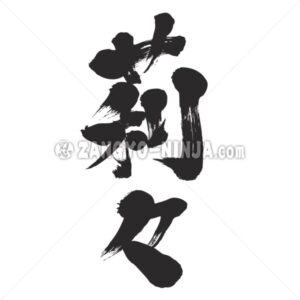
woman’s name Lille Lilly Lily in Kanji - Zangyo-Ninja

Your (her/his) name became a Kanji character. This used as a phonetic symbol rather than for its meaning.

not rated $0.00$1,490.00 Select license
Fukushima in Kanji - Zangyo-Ninja

Description for Fukushima Fukushima Prefecture is the name of the prefecture with the third-largest area in Japan after Hokkaido and Iwate Prefecture, and it is also the name of the prefectural capital. A city in Japan. a prefecture in Japan called Fukushima. The Fukushima Daiichi nuclear disaster following a tsunami in 2011. One of … Read More

vector
not rated $0.00$1,490.00 Select license
Mori in Kanji, Katakana and Hiragana - Zangyo-Ninja

The Origin of the Mōri Clan Name. A Sengoku daimyō and early modern daimyō. Their ancestor was Suemitsu, son of Ōe no Hiromoto, who resided in Mōri Manor in Sagami Province and adopted the Mōri name. In 1270, Tokichika inherited the position of jitō (land steward) of Yoshida Manor in Aki Province from his … Read More

vector
not rated $0.00$1,490.00 Select license