
Abbreviations for Prefecture and City Names
A prefecture occupying roughly the central part of the Kinki region. Located near the center of Japan, the Nara Basin in the northern part of the prefecture was celebrated throughout the Asuka and Nara periods as the “heart of the nation” and the “land of plenty,” flourishing as a center of politics and culture. Bordered by Kyoto Prefecture to the north, Mie Prefecture to the east, Osaka Prefecture to the northwest, and Wakayama Prefecture to the southwest, it is one of Japan’s few inland prefectures. It is also the name of the prefectural capital city.
Nara is sometimes written as 平城, 寧楽, or 諾楽, but all are phonetic substitutions for “Nara,” with 平 (narasu) said to be the origin of the place name.
From 710 (Wadō 3) to 784 (Enryaku 3), Heijokyo served as the capital, becoming the political center. At the foot of Mount Kasuga and Mount Katsuragi (Wakakusa) in the east, the temples Gango-ji, Kōfuku-ji, and Tōdai-ji, along with Kasuga Taisha Shrine, were established.
Nara Park’s “Nara Deer”
The ‘Nara Deer’ are wild animals that have inhabited Nara for over 1,300 years. Recognized for their harmonious coexistence with humans, they are designated as a National Natural Monument. Considered descendants of divine messengers, they are protected but not kept in captivity. Being wild, they will not attack unless provoked.
Roots of Japanese Food Culture
Essential ingredients in Japanese cuisine like tea, udon noodles, sake, manju sweets, and tofu are said to have their roots in Nara.
The cultivation of tea in Japan began with seeds sown at Buryū-ji Temple in Uda City.
Shōryaku-ji Temple in Nara City is the birthplace of sake.
The Hayashi Shrine, dedicated to Hayashi Jōin no Mikoto—who created Japan’s first manju filled with sweet red bean paste—is located within the Kankoku Shrine near Kintetsu Railway’s Nara Station.
Abbreviation for a Historical Period
An abbreviation for the Nara period. It refers to the 74-year span from the relocation of the capital to narasu-kyō in 710 to the move to Nagaoka-kyō in 784, or more broadly, the 84-year period extending to the relocation to Heian-kyō in 794. This era saw the foundation of the Ritsuryō state system and the flourishing of Buddhist culture.
Nara as a surname
Approximately 30,000 people in Japan bear this surname. That’s enough to fill the New Las Vegas Stadium.
The most widely accepted theory suggests the surname originates from the place name Nara. Its etymology is similar to the name’s formation, derived from the verb “to flatten” (nirasu), with the current kanji characters later assigned.
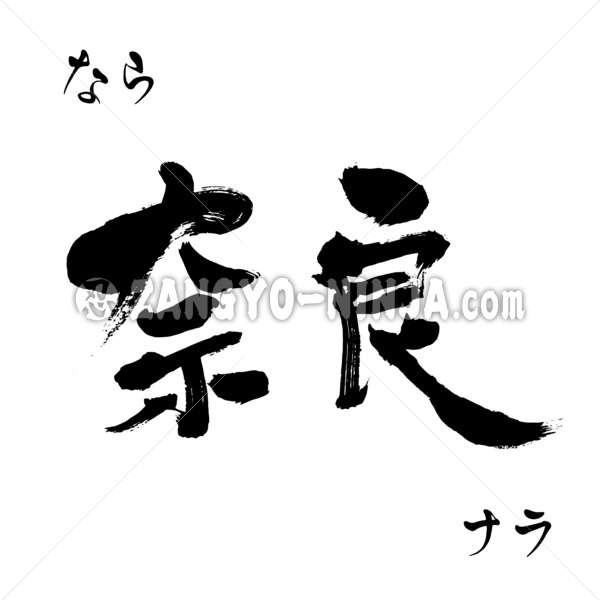
Explanation of this calligraphy
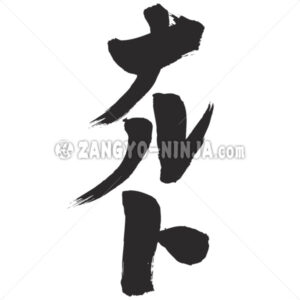
The top row is in hiragana, the middle row in kanji, and the bottom row in katakana, all written horizontally.