

Place names and environments as origins
The place name “Aoki” exists in numerous locations nationwide, giving rise to “Aoki” clans that adopted these names in various regions. Place names like ‘Aoki’ exist throughout Japan, including in Kanagawa Prefecture, Fukuoka Prefecture, and Niigata Prefecture, each serving as the origin of the “Aoki” surname.
Another theory suggests the name refers to places where trees, like the Aoki tree, are always lush and green. People living in such areas came to adopt the surname “Aoki.”
Why did the Japanese call green “blue”?
“Ao” originally meant blue, representing the sea or a clear sky. Did trees of that color exist? No, blue trees never existed, even in ancient times. Trees with lush green leaves did exist. Calling green ‘blue’ stems from ancient Japanese, where the color green was included within the concept of “blue.” Even today, calling a green apple “aoriingo” (青りんご) seems to be a remnant of this old usage.
The Legendary Origin of the Aoki Clan
Some clans trace the name “Aoki” to a completely different origin. The most prominent example is the Aoki clan of Manazuru, Kanagawa Prefecture. Minamoto no Yoritomo, who raised an army to overthrow the Heike clan, was defeated by the Heike forces at the Battle of Ishibashiyama. He then hid in the “Shitodo Cave” deep in the mountains of Manazuru.
However, remaining hidden there risked discovery. It is said that the local residents placed Aoki trees at the entrance to camouflage the cave. Aoki trees are green not only in their leaves but also in their stems. By blocking the entrance to the cave where Yoritomo and his men were hiding with these trees, they managed to evade pursuit by the Heike forces.
The saved Yoritomo bestowed the surname “Aoki” upon the villagers. To this day, “Aoki” remains the most common surname in Manazuru Town.
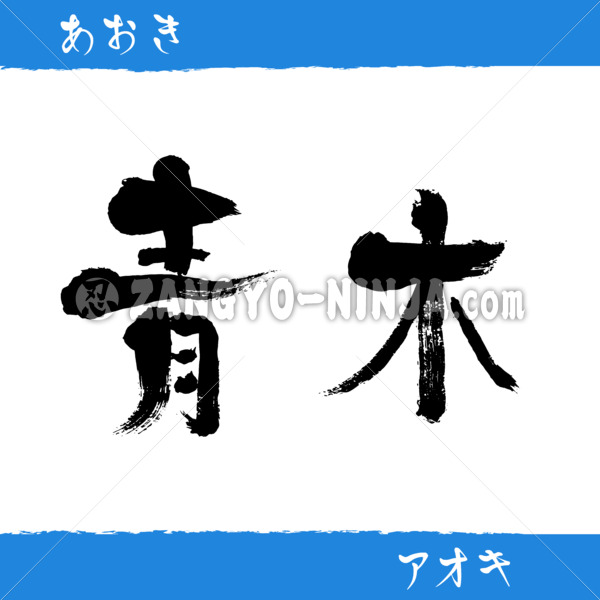
Explanation of this calligraphy
The top row is in hiragana, the middle row in kanji, and the bottom row in katakana, all written horizontally.