


Description for Hippopotamus
The second-largest land mammal after the elephant.
Once inhabited rivers throughout Africa, but by the late 20th century, it had nearly become extinct north of Khartoum in Sudan and south of the Zambezi River, except for a few reserves like Kruger National Park.
Once inhabited rivers throughout Africa, but by the late 20th century, it had nearly become extinct north of Khartoum in Sudan and south of the Zambezi River, except for a few reserves like Kruger National Park.
Adult males reach a body length of 4.2 meters, a shoulder height of 1.5 meters, and a weight of up to 3 tons. Females are slightly smaller, weighing around 1.5 to 2 tons.
Their coat is dark reddish-brown. They secrete a reddish-brown liquid called “blood sweat” from small pores in their skin, which protects it.
Their coat is dark reddish-brown. They secrete a reddish-brown liquid called “blood sweat” from small pores in their skin, which protects it.
They typically live in herds of 20 to 100 individuals, spending most of the day in the water. Only their eyes and nostrils remain above the surface; if anything suspicious approaches, they immediately submerge to hide. Activity mainly occurs in the early morning and from evening into night, when they spend long periods grazing on grasses near the water’s edge.
The Western name “hippopotamus” derives from the Greek hippopotamos (meaning “river horse”), as their vocalizations and appearance were thought to resemble a horse.
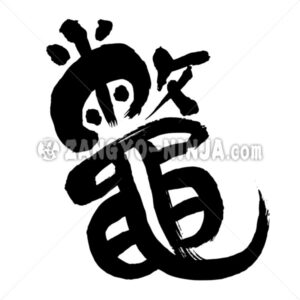
Explanation of this calligraphy
The top row is in hiragana, the middle row in kanji, and the bottom row in katakana, all written horizontally. It reads “カバ” (kaba) in Japanese.