
Description for Judo
It has been an official Olympic sport since the 1964 Tokyo Games, and a women’s event since the 1992 Barcelona Games.
Overview of Judo Techniques
Judo techniques consist of three categories: throwing techniques (standing techniques, sacrifice throws), holding techniques (pinning techniques, strangulation techniques, joint locks), and striking techniques (striking, punching, kicking). In randori (practice) and matches, dangerous techniques like striking are prohibited.
Competition Rules and Scoring
The official competition area is a 50-mat tatami space (approximately 9.1m square). Competitors wear a judogi. Matches are held in open weight or weight-class divisions and are single-point matches within a set time limit (3 to 20 minutes).
If no Ippon is scored, victory is determined by superiority based on criteria such as Waza-ari (advantage point), Keikoku (warning), Yuuko (effective point), and Chui (caution) (international rules add Kōka (effective action) and Shido (admonition)).
Dan ranks (10th Kyu to 1st Dan) and Kyu ranks (1st Kyu to 5th Kyu) are examined and certified by the Kodokan.
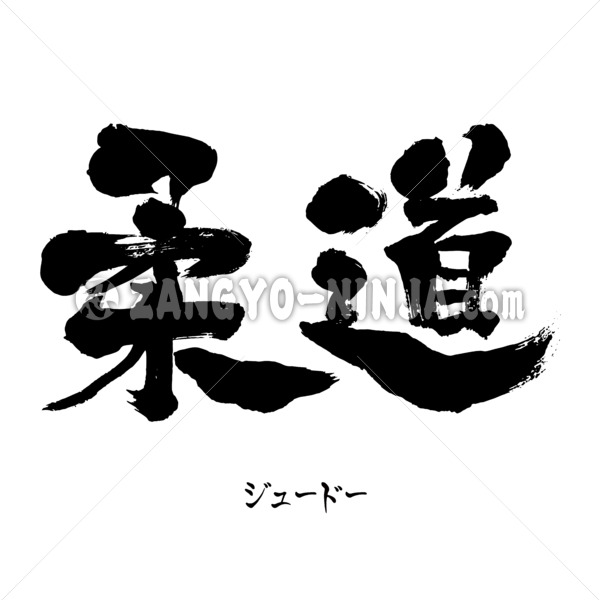
Explanation of this calligraphy
The top section is in kanji, the bottom in katakana, all written horizontally.
The kanji “柔” (yawara) signifies softness and flexibility. “道” (dō) means ‘way’ or “path,” a character frequently used in Japanese sports and performing arts. It conveys the idea of walking a path forward. This path is not a single straight road; it sometimes branches or connects, sometimes ascends or descends, and can be easy to traverse or rugged.