
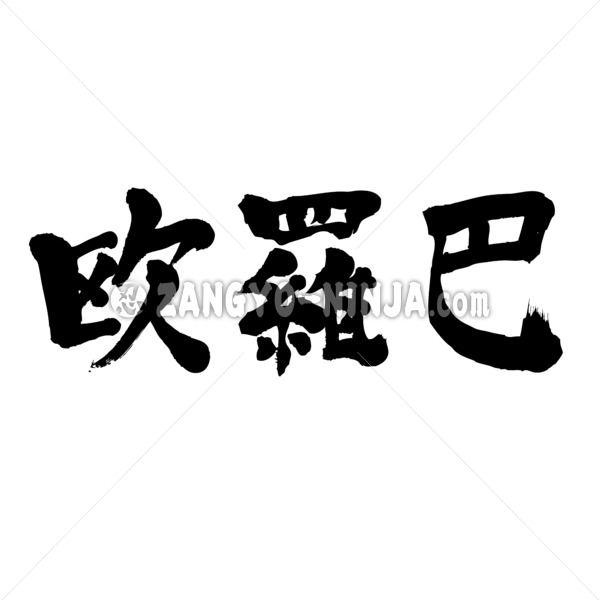
Description for Europe
Europe. One of the six major continents. It occupies the peninsula-like portion of western Eurasia. The name is said to derive from the ancient Assyrian word “ereb,” meaning ‘sunset’ or “west.” Generally, Europe refers to the continental portion west of a line connecting the Dardanelles Strait, the Black Sea, the Caucasus Mountains, the Caspian Sea, and the Ural Mountains, as well as the islands of the Mediterranean Sea, the United Kingdom, Iceland, and other regions.
There is no clear geographical boundary to the east.
It is a peninsula-like landmass protruding from the western part of the Eurasian continent, bounded by the Arctic Ocean to the north, the Atlantic Ocean to the west, and the Mediterranean Sea to the south. There is no clear geographical boundary to the east. Historically, the term “Europe” referred to the region west of a line extending from the Ural Mountains through the Emb River to the Caspian Sea, including European Russia. However, in recent United Nations statistics, the former Soviet Union is often excluded. Additionally, while the Turkish territory west of the Bosporus Strait is geographically part of Europe, it is generally classified as Asia in statistical data.
Europe is composed of the following countries.
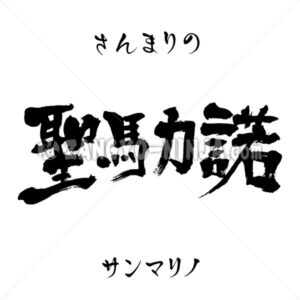
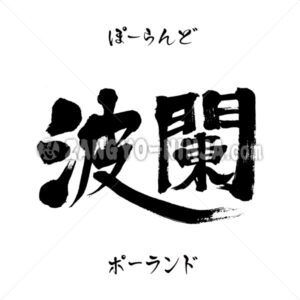
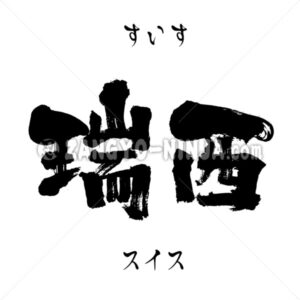
This region, which includes many islands such as Great Britain, Ireland, and Iceland, includes the United Kingdom, Albania, Andorra, Austria, Belgium, Bosnia and Herzegovina, Bulgaria, Croatia, the Czech Republic, Denmark, England, Estonia, Finland, France, Germany, Greece, Hungary, Iceland, Ireland, Italy, Kosovo, Latvia, Liechtenstein, Lithuania, Luxembourg, Malta, Monaco, Montenegro, the Netherlands, North Macedonia, Norway, Poland, Portugal, Romania, San Marino, Scotland, Serbia, Slovakia, Slovenia, Spain, Switzerland, Sweden and Vatican City.
However, the boundaries are sparse in terms of history and economic zones.
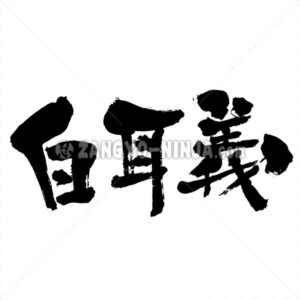
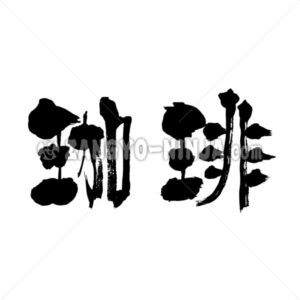
The etymology of this kanji
During the late Warring States period to the early Edo period, the term was borrowed from the Portuguese word “Europa” and written as “Eurōpa.” Alternatively, it is derived from the Greek mythological goddess Eurōpē and written as “Eurōpa.” It was also written as “Eurauha,” a Semitic word meaning “the place where the sun sets.” These terms were then transcribed into Chinese characters.