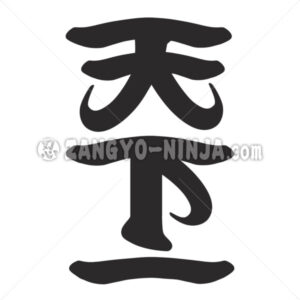


A daimyo family of the Azuchi-Momoyama period.
It began when Hideyoshi was appointed Grand Minister of State in 1586 and granted the Toyotomi surname.
History of the Toyotomi Clan
Hideyoshi, originally from the Kinoshita clan of Owari Province, became a senior retainer of Oda Nobunaga and changed his surname to Hashiba in 1573 (Tenshō 1). Though he had used the Hei surname, upon becoming Kampaku in 1585, he became the adopted son of Konoe Sakihisa and took the Fujiwara surname. The following year, upon becoming Sesshō, he received the Toyotomi surname from the Imperial Court. Hideyoshi had his clan adopt the Toyotomi surname and also granted the Hashiba and Toyotomi surnames to various daimyo. When his eldest son Tsurumatsu died young in 1591, he made his sister’s son Hideie his successor by transferring the position of Kampaku to him. However, after his second son Hideyori was born, he exiled Hideie to Mount Koya in 1595 (Bunroku 4), forcing him to commit suicide, and made Hideyori his successor. This incident involving Hideyori, coupled with the failure of the Korean Campaign, weakened the Toyotomi regime. After Hideyoshi’s death, the Battle of Sekigahara transferred power to the Tokugawa clan. The Toyotomi clan was ultimately destroyed by the Tokugawa in the two Sieges of Osaka in 1614 (Keichō 19) and 1615 (Genna 1).
Even today, very few people retain the Toyotomi surname.
The main Toyotomi family line was extinguished. It is Japan’s newest clan name. It is said to be the fifth clan name, following Minamoto, Taira, Fujiwara, and Tachibana, bestowed upon various military commanders. Most ceased using it after the Toyotomi family’s downfall. A small number remain in Tokyo, Chiba, and Saitama Prefectures.
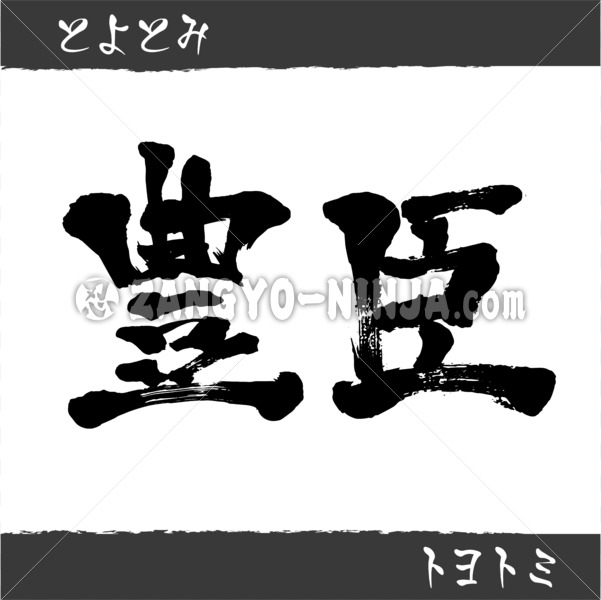
Explanation of this calligraphy
The top row is in hiragana, the middle row in kanji, and the bottom row in katakana.