
Gyokuro’s Components and Benefits
Gyokuro is rich in amino acids (theanine), which promote relaxation, as well as caffeine, which enhances concentration, and vitamin C. While its caffeine content is slightly higher than that of sencha and other teas, it is said that theanine helps mitigate the stimulating effects of caffeine.
Major Production Areas
Gyokuro is an extremely rare tea, accounting for only about 0.3% of Japan’s total tea production.
- Uji (Kyoto Prefecture): A historic production area considered the birthplace of Gyokuro.
- Yame (Fukuoka Prefecture): A renowned production area where teas such as “Traditional Hon-Gyokuro” are produced using shade-grown cultivation with natural materials, and which receives high praise at tea competitions.
- Asahina and Okabe (Shizuoka Prefecture): One of the three major production regions, blessed with a climate characterized by significant temperature fluctuations and frequent fog.
- Chiran and Kagoshima (Kagoshima Prefecture): Quality has improved in recent years, and many varieties with strong umami and aroma are now cultivated here.
You can take your time to savor its rich flavor—which is a cut above everyday sencha and feels almost like drinking high-quality dashi broth.
Tips for Brewing Delicious Gyokuro
To bring out the “umami”—the defining characteristic of Gyokuro—to the fullest, the temperature of the water used for brewing is of utmost importance.
- Brew at a low temperature: Transfer boiling water to a cooling vessel or teacup to let it cool to about 50–60°C.
- Take your time: Use slightly more tea leaves than usual, pour the low-temperature water over them, and wait patiently for about 2 to 2½ minutes.
- Every last drop: Since the umami is concentrated here, pour the tea until the very last drop is squeezed out of the teapot.
Origin and Meaning of the Kanji
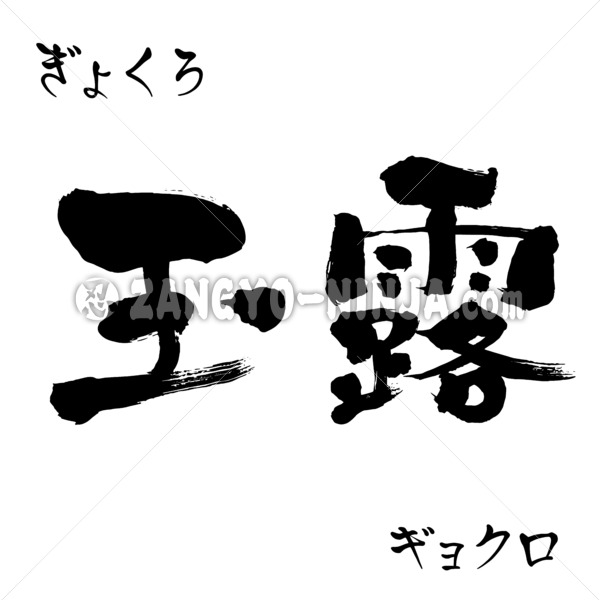
The top row is in hiragana, the middle row in kanji, and the bottom row in katakana; all are written horizontally.
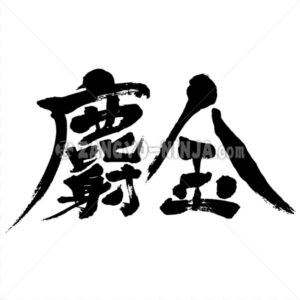
The kanji for “Gyokuro” embody the following beautiful origins and meanings.
- Gyoku (玉): Refers to a gemstone or something that shines beautifully (or a green stone such as jade).
- Ro (露): Means “morning dew” that forms on plants. Combined, these characters convey the meaning of “a crystal-clear drop that shines as beautifully as a gemstone.”
The name was chosen to evoke the image of a beautiful, lush green tea infusion that glistens like morning dew on leaves.