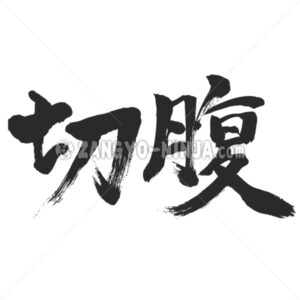

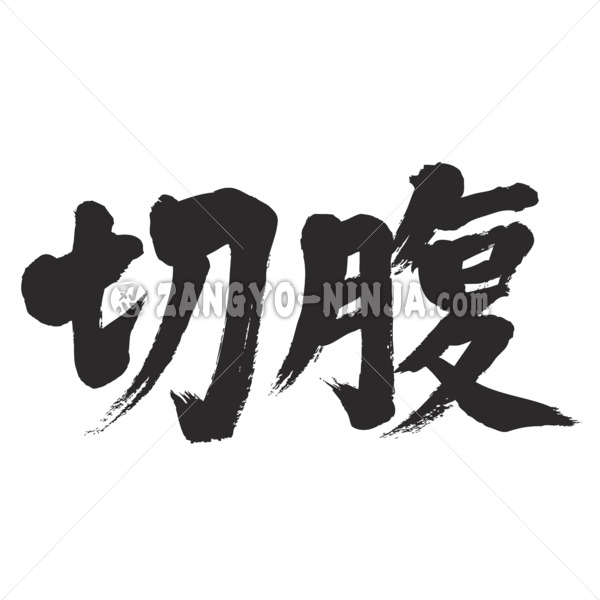

Description for Harakiri (read as Seppuku)
1. Use your own sword to cut your stomach and die.
2. One of the punishments imposed on samurai during the Edo period. The lightest of the death penalty. In front of the autopsy, a kaishakunin shot down his neck from behind as he cut his belly. Japan calls Seppuku, hara-kiri, harikari.
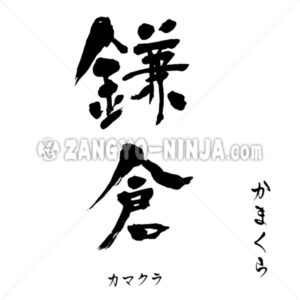
It is a method of self-determination that cuts the belly with a dagger and dies. It is said to have started in the Heian period, and it was established until the Kamakura period when Bushido was developed, and it was held throughout the Middle Ages and the early modern period. From the idea that the human soul resides in the belly, bravely cutting the belly was the best act to carry out Bushido. Motivations include pursuit of the lord (Oibara), stubbornness in terms of responsibilities and in-laws (claw roses), seppuku to escape the shame of prisoners of war, and seppuku that is too regrettable. It was said that the method of cutting is a one-character belly that is cut into one character, and a cross-shaped belly that is cut vertically from the epigastrium to the bottom of the navel. It seems that it led to death. In the Edo period, the purity of motivation was lost and the method was formalized. In other words, it is a method of kaishakunin, in which the samurai’s seppuku is accompanied and the neck is cut off. Gradually, the kaishakunin slashed his neck from behind just before he was hungry.
In fact, even if you split your stomach by yourself, you will not die immediately.
Kaishakunin worked with three people. The three kaishakunin are the three roles of kaishakunin (also known as Daisuke kaishakunin), soe kaishakunin (also known as suke kaishakunin), and kosuke kaishakunin. The role of bringing out the three sides, Kosuke Kaishakunin, is the role of putting the neck in the actual inspection. In addition, he had the knowledge of “three rules” and “four rooms” to slash his neck. One of the “three rules” is when you receive a dagger, two when you look at the left belly, three when you thrust the dagger into the belly, and one of the “four spaces” when you retreat with three sides. Two were when pulling three sides, three when grasping a sword, and four when thrusting into the belly, and it was said that these should not be too early or too late. However, it is not a dagger that is on three sides, but a fan, which is called a fan belly.
Even in modern times, there were cases of Harakiri.
In addition to self-determination, seppuku has been adopted as a method of execution since the Middle Ages. As an honorary sentence for a senior samurai, he was given seppuku from the idea of dealing with his own mischief on his own. In the case of the sergeant’s criminal, the sergeant’s seppuku was done in the mansion such as the entrusted daimyo, and in the prison. This punishment for seppuku was abolished in 1873 (Meiji 6). As a method of suicide, it has been seen occasionally even after the Meiji era, and on August 25, 1945 (Showa 20), at a corner of the former Yoyogi training ground in Tokyo, Sogyo, “Daito Juku” “Juku) 14” made a group suicide decision based on the old style. In recent years, there is an example of the writer Yukio Mishima’s seppuku (1970).